I hear a version of the same question in my office almost every week.
Not “Will this work?”
But something quieter.
“If I stop using… will I still be me?”
For people considering change, especially those who feel creative, social, or emotionally intense, this fear is real. And if you’re exploring options like opiate recovery support in Ohio, it may be the question sitting quietly underneath everything else.
Let me tell you what I’ve seen after years of sitting across from people at that exact crossroads.
The Fear Isn’t Silly, It’s Honest
Substances don’t just numb pain.
For many people, they also unlock things that feel meaningful:
- Confidence at parties
- The courage to speak up
- A burst of creativity
- The ability to feel deeply or escape deeply
So when someone says, “I’m afraid I’ll become boring,” they’re not being dramatic.
They’re protecting the parts of themselves they care about.
And that fear deserves respect.
Many People Associate Their Best Moments With Using
A musician once told me:
“Every song I’ve written that people love… I wrote when I was high. What happens if that version of me disappears?”
A comedian worried sobriety would take away their edge.
A young professional feared they’d lose their social spark.
These concerns aren’t rare. They’re incredibly common.
When substances have been tied to your identity, the idea of letting them go can feel like erasing part of your personality.
What Actually Happens Is Usually the Opposite
Here’s the part most people don’t expect.
When substances slowly loosen their grip, people often rediscover the traits they thought drugs or alcohol created.
Creativity returns — but clearer.
Humor comes back — but more present.
Connection deepens — because it’s real.
One patient described it this way:
“I thought I was losing my personality. It turns out I was getting it back.”
Substances can amplify emotions in the moment.
But over time, they quietly flatten the deeper parts of who someone is.
Recovery tends to reverse that.
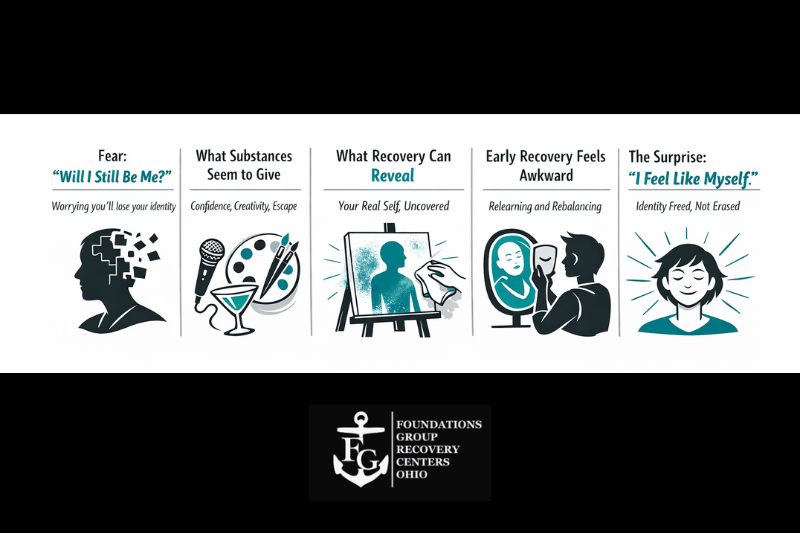
Recovery Doesn’t Replace You It Reveals You
Think of identity like a painting under layers of dust.
Substances can feel like the brush that makes the colors brighter. But over time, they often become the dust itself.
When people begin healing, what emerges is rarely a brand-new personality.
Instead, I see:
- The same humor just quicker and sharper
- The same creativity but more sustainable
- The same emotional depth without the chaos attached
Sobriety isn’t about becoming someone else.
It’s about becoming someone less buried.
The First Months Can Feel Strange
I won’t pretend the adjustment is always smooth.
Early recovery can feel awkward.
People sometimes say:
- “I don’t know how to socialize yet.”
- “My emotions feel louder.”
- “I’m relearning who I am.”
That phase is normal. It’s the mind recalibrating.
But with time, people develop something they rarely had before: a stable version of themselves.
Not a muted one.
A grounded one.
The Most Surprising Change People Report
When I ask people a year into recovery what surprised them most, the answer is rarely what they expected.
It isn’t “I became a different person.”
It’s usually something like:
“I finally feel like myself again.”
That’s the quiet truth many people discover after entering substance use treatment Ohio programs: sobriety doesn’t erase identity.
It gives it room to breathe.
If This Fear Is Holding You Back
If part of you is curious about recovery but another part whispers, “What if I disappear?” — you’re not alone.
That fear shows up in artists, parents, students, executives, comedians, athletes, and musicians.
And in my experience, the outcome is rarely what people fear.
The color doesn’t fade.
It just stops being borrowed.
If you’re wondering what healing could look like for you, compassionate help is available. Call (888)501-5618 or visit our page about substance use treatment Ohio, opiate addiction treatment Ohio to learn more about supportive options that meet you where you are.