It usually doesn’t start with something dramatic.
It’s not a DUI. Not a lost job. Not even a big fight.
It’s a quieter moment—maybe a Tuesday night, maybe a Sunday morning—where a thought slips in and doesn’t leave:
“What if I’d actually feel better without this?”
That question matters more than people realize. And if it’s been showing up for you, even gently, it’s worth paying attention to.
If you’re starting to explore that feeling, you can learn more about structured daytime support through this partial hospitalization program in Ohio—a place where people sort through these exact questions without pressure or labels.
Step 1: Notice the Subtle Ways Drinking Is Taking Up Space
Most people in this stage aren’t drinking all day.
They’re functioning. Showing up. Holding things together.
But something feels… off.
You might notice:
- You think about drinking more than you used to
- You plan your evenings around it—even casually
- You feel slightly disconnected the next day
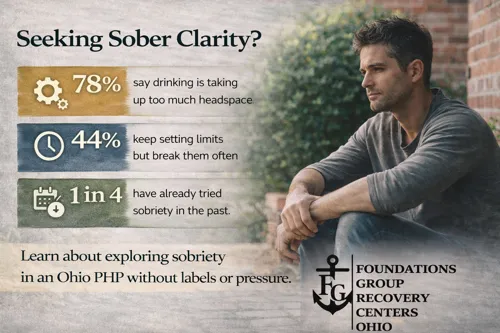
- You keep setting small limits… and quietly breaking them
None of this looks extreme from the outside.
But internally, it creates a kind of tension that’s hard to explain.
It’s like carrying a low-level hum of discomfort everywhere you go.
Step 2: Let Yourself Question It Without Jumping to Conclusions
One of the biggest barriers people face is the fear of what questioning might mean.
“If I look at this too closely, does that mean I have a problem?”
Not necessarily.
You’re allowed to explore your relationship with alcohol without deciding anything right away.
You don’t need a label.
You don’t need to commit to forever.
You don’t need to justify why you’re curious.
You just need space to be honest.
And for a lot of people, that honesty has been missing—not because they’re hiding, but because they’ve never had the right environment to look clearly.
Step 3: Step Out of Your Usual Environment (Even Briefly)
Trying to figure this out in your normal routine can feel impossible.
You’re surrounded by the same triggers. The same habits. The same patterns.
That’s why a more structured daytime setting can be so powerful.
It gives you:
- A break from autopilot
- Time to think without distraction
- Conversations that go deeper than surface-level reassurance
You’re not removed from your life—you still go home at night.
But during the day, things slow down just enough for clarity to show up.
And clarity changes everything.
Step 4: Understand What Drinking Has Been Doing For You
Here’s something people don’t expect:
We don’t start by telling you to stop.
We start by asking why it’s there.
Because drinking usually serves a purpose:
- It softens anxiety
- It fills quiet moments that feel uncomfortable
- It helps you socialize or unwind
- It creates a pause from pressure, expectations, or overthinking
If you take it away without understanding that role, something feels missing.
So instead, we help you map it out:
- What do you reach for alcohol to feel?
- What do you hope it helps you avoid?
- What’s actually happening underneath the surface?
This is where things shift—from “Should I stop?” to “What do I actually need?”
Step 5: Be Around People Who Get It (Without Making It Bigger Than It Is)
There’s something grounding about hearing someone describe your exact experience—without exaggeration.
Not worse than yours. Not better. Just… familiar.
You might hear:
“I kept telling myself I just needed more discipline. But it wasn’t about discipline.”
Or:
“Nothing looked wrong from the outside. That’s what made it harder to trust my gut.”
These moments don’t push you.
They don’t label you.
They just reflect something back to you that you may not have been able to see clearly on your own.
And that reflection can be the turning point.
Step 6: Experience What It Feels Like to Have Support Without Pressure
A lot of people hesitate to reach out because they think support will come with expectations.
That someone will tell them:
- “You have to quit.”
- “You need to commit.”
- “This is serious.”
But real support doesn’t rush you.
It meets you exactly where you are.
You can:
- Ask questions without committing to answers
- Share honestly without being judged
- Explore change without being forced into it
This is especially important for people who are sober curious.
Because the goal isn’t to push you into a decision—it’s to help you make one that actually feels right.
Step 7: Build a Version of Your Life That Feels Better—Not Just Different
This is where things become real.
Not in a dramatic way—but in a grounded, steady one.
You start noticing:
- Mornings feel clearer
- Your mood isn’t swinging as much
- You’re more present in conversations
- You don’t feel like you’re negotiating with yourself all the time
And maybe most importantly…
You start trusting yourself again.
Because the goal isn’t just to remove drinking.
It’s to build something that makes drinking feel less necessary.
Some people exploring care in Columbus, Ohio and Franklin County, Ohio come in unsure if they even belong in a program like this.
What they often find is not intensity—but clarity.
Not pressure—but perspective.
And that’s usually what they needed all along.
Frequently Asked Questions
Do I need to identify as an alcoholic to get help?
No. Many people who seek support are simply questioning their habits. You don’t need a label to explore whether something could feel better.
What if my drinking doesn’t seem “bad enough”?
That’s more common than you think. If it’s bothering you, affecting your mood, or taking up more space than you’d like—that’s enough reason to look at it. You don’t need to wait for it to get worse.
Will I be forced to quit drinking?
No. This kind of care focuses on helping you understand your relationship with alcohol first. From there, you can decide what changes—if any—feel right for you.
Can I still work or handle responsibilities?
Yes. This is designed to fit into your life, not replace it. You attend during the day and return home in the evening.
What makes this different from trying to cut back on my own?
When you try on your own, you’re relying on willpower and self-awareness at the same time—which can be exhausting.
With support, you get:
- Outside perspective
- Structured time to reflect
- Tools that actually match what you’re experiencing
It’s not about trying harder. It’s about understanding better.
What if I’m still unsure?
That’s okay. Uncertainty is part of the process. You don’t have to feel 100% ready to take a step—you just have to be willing to explore.
You Don’t Have to Wait for a Breaking Point
A lot of people believe they need a clear reason to get help.
A crisis. A consequence. A moment they can point to and say, “That’s why.”
But more often, the real reason is quieter:
“I don’t feel like myself anymore.”
“I think something could be better than this.”
“I’m tired of going back and forth in my head.”
That’s enough.
You don’t need everything to fall apart to start paying attention.
If you’ve been circling this question for a while, it might be time to explore what support could look like—without pressure, without labels, and without having to decide everything today.
Call (888)501-5618 to learn more about our Partial Hospitalization Program in Columbus, Ohio.
Built with guidance from the Prompt-to-Publish system and — helping writers create content that actually reaches people in the moments that matter.