
You’ve probably replayed the same conversations in your head more times than you can count.
Did I miss something?
Should I have stepped in sooner?
Am I overreacting… or not reacting enough?
If your young adult is struggling with alcohol or substance use, the hardest part isn’t always what’s happening—it’s not knowing what to do next.
If you’re beginning to explore options, this kind of structured daytime support can offer something many families don’t realize they need at first: space, clarity, and shared responsibility.
The Weight Parents Carry (That No One Really Sees)
There’s a quiet exhaustion that comes with loving someone who’s struggling.
You’re watching closely—but trying not to hover.
You’re asking questions—but trying not to push.
You’re worried—but trying to stay calm.
It’s a constant balancing act.
And underneath it all is a fear most parents don’t say out loud:
“What if this gets worse… and I didn’t do enough?”
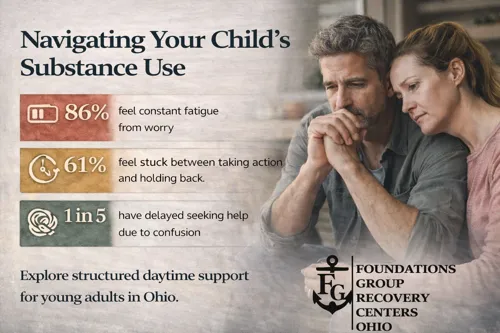
That fear can keep you stuck between action and hesitation.
Why This Doesn’t Always Look Like a Crisis
Many parents expect addiction to look obvious.
But with young adults, it often doesn’t.
They might still:
- Go to work or school
- Maintain friendships
- Show moments of “normal” behavior
Which makes everything more confusing.
Because you’re not responding to one big moment—you’re responding to a pattern that feels off.
And patterns are harder to trust when they don’t come with clear proof.
The Breaking Point Most Families Wait For (and Why It’s Risky)
It’s natural to wait for something definitive.
A moment where you can say, “Okay, now we know this is serious.”
But that moment often comes later than anyone expects.
In the meantime:
- Habits deepen
- Emotional distance grows
- Trust quietly erodes
Not dramatically. Just gradually.
And by the time things feel undeniable, the situation can feel much heavier than it needed to be.
What Changes When Support Enters the Picture
Right now, you might feel like everything depends on you.
What you say. What you notice. What you allow.
That’s a lot for one person—or even one family—to carry.
When your child enters a structured daytime setting, something important shifts:
- You’re no longer the only one trying to understand what’s happening
- Your child hears perspectives that don’t come from a parent-child dynamic
- The pressure on your relationship starts to ease
It’s not about stepping back—it’s about not having to hold everything alone.
Why Structure Matters More Than Advice
You’ve probably already had conversations.
Maybe many.
You’ve tried:
- Reasoning
- Encouraging
- Setting boundaries
- Giving space
And still… things circle back.
That’s because insight alone rarely creates change.
Structure does.
A consistent environment—one that your child shows up to regularly—creates something conversations can’t:
- Accountability without conflict
- Reflection without defensiveness
- Support without emotional history attached
It’s not louder than what you’ve been doing.
It’s just steadier.
The Age Where Everything Feels Unstable (But Also Changeable)
Young adulthood is a strange in-between.
They’re expected to be independent—but still figuring out who they are.
They want freedom—but don’t always have the tools to manage it.
Substance use often fills that gap.
Not because they’re careless—but because they’re overwhelmed in ways they don’t always understand.
Here’s the hopeful part:
This stage is one of the most responsive to change.
With the right support, young adults can:
- Learn emotional regulation skills they’ve never been taught
- Rebuild confidence without relying on substances
- Reconnect with purpose before patterns become deeply rooted
It’s not too early. And it’s not too late.
What Parents Start to Notice First
Before anything becomes obvious, there are usually small shifts.
You might see:
- Less openness in conversations
- Increased irritability or withdrawal
- Changes in sleep or energy
- A sense that they’re not fully present—even when they’re there
These signs don’t always point to something extreme.
But they do point to something meaningful.
They’re signals that your child might be struggling in ways they can’t—or won’t—fully explain yet.
The Role You Play Changes (But Doesn’t Disappear)
One of the biggest fears parents have is losing their role.
That if outside help comes in, they somehow matter less.
The opposite is true.
Your role shifts from:
- Being the only source of support
To:
- Being part of a system that supports your child more effectively
You’re still the foundation.
But now, you’re supported too.
And that changes how you show up—less reactive, more grounded, more connected.
What a Turning Point Actually Looks Like
It’s rarely dramatic.
There’s no single moment where everything suddenly makes sense.
Instead, it looks like:
- Your child starts showing up consistently
- Conversations become slightly more open
- Defensiveness softens, even just a little
- You feel less like you’re walking on eggshells
These are small shifts.
But they’re the beginning of something bigger.
Because real change doesn’t explode into existence—it builds.
Some families exploring care options in Columbus, Ohio find that simply having their child in a consistent, supportive daytime environment creates more progress than months of trying to manage things at home alone.
Others in Upper Arlington, Ohio describe a different kind of relief—the kind that comes from finally not being the only one trying to hold everything together.
The Hard Truth Parents Need to Hear (Gently)
You didn’t cause this.
And you can’t fix it alone.
That’s not a failure. It’s reality.
But what you can do is create an opportunity for change.
You can:
- Recognize that something isn’t right
- Choose not to ignore it
- Open the door to support that goes beyond what’s possible at home
That decision matters more than you think.
Frequently Asked Questions
How do I know if this is serious enough to act on?
If you’re asking that question repeatedly, it’s already serious enough to explore.
You don’t need a crisis to justify concern.
What if my child refuses help?
That’s common.
Support doesn’t always begin with full agreement—it often starts with conversation, curiosity, and gradual openness.
The key is how the option is presented: with care, not control.
Will this damage our relationship?
Handled thoughtfully, it often strengthens it.
Because it removes the constant tension of trying to manage everything at home.
It allows your relationship to breathe again.
Can they still live at home?
Yes.
They return home each day, which keeps connection intact while adding consistent outside support.
What if I feel like I’ve already tried everything?
Most parents have.
And that’s exactly why structured support can help—it introduces something different, not just more of the same.
Is it too early to consider this?
Early action is often what creates the best outcomes.
Waiting doesn’t make things clearer—it usually makes them more complicated.
You’re Allowed to Act Before Things Get Worse
There’s a belief many parents carry:
“We should wait until we’re sure.”
But certainty often comes late.
Concern comes early.
And concern is enough.
Because the goal isn’t to prove how bad things are.
It’s to give your child a chance to experience something better before things go further off track.
If you’re ready to take that step,call (888)501-5618 to learn more about our Partial Hospitalization Program in Columbus, Ohio.
Built with guidance from the Prompt-to-Publish system and — helping you reach families in the moments where clarity matters most.