Sometimes life gets messy.
Your car broke down. Your boss changed your schedule. Childcare fell apart. Or maybe it wasn’t external at all—maybe old habits, depression, or shame crept in, and showing up got harder and harder… until you didn’t.
If you stopped attending your intensive outpatient program—whether it’s been a few days or a few months—you might be wondering:
“Can I come back?”
“Will they even want me back?”
“Do I have to start over from the beginning?”
At Foundations Group Recovery Center in Upper Arlington, OH, we want to be clear:
You’re still welcome.
Here’s what restarting IOP can look like, and why it’s more normal—and more possible—than you think.
Start by learning about our IOP program here.
1. You’re Not the Only One Who’s Paused
Dropping out of IOP isn’t a sign of failure. It’s a sign that you’re living life—real, unpredictable, and often overwhelming.
We’ve seen dozens of people leave and come back. Some missed a week. Others ghosted for months. Some returned ashamed. Others returned in crisis. All were met with the same message:
You’re still allowed to get better.
2. We Don’t Need a Perfect Explanation
If you’re scared someone’s going to interrogate you—don’t be. You don’t have to explain every detail. You don’t have to come up with a good enough reason to earn your spot back.
Sometimes, all you need to say is, “I’m ready to come back.”
We might ask how you’re doing and what support would help right now—but that’s to serve you, not to judge you.
3. We Build from Where You Are Now
One of the strengths of an intensive outpatient program is that it meets you where you are.
Did you complete the first two weeks before stepping away? We can look at picking up close to where you left off.
Has it been longer? We’ll talk about whether a gentle reset makes sense. But no matter what, we’ll help you create a plan that reflects today—not punish you for the past.
4. You Don’t Have to Pretend You’re Fine
If things got worse after you left, you’re not alone.
Many people struggle more in the weeks after leaving treatment—especially if the exit was unplanned. You might have slipped into old behaviors, felt isolated, or even told yourself it was too late to come back.
We want you to know: nothing you say will shock us.
Tell the truth—however messy it feels. That honesty is what builds a treatment plan that works.
5. We Expect Detours in Recovery
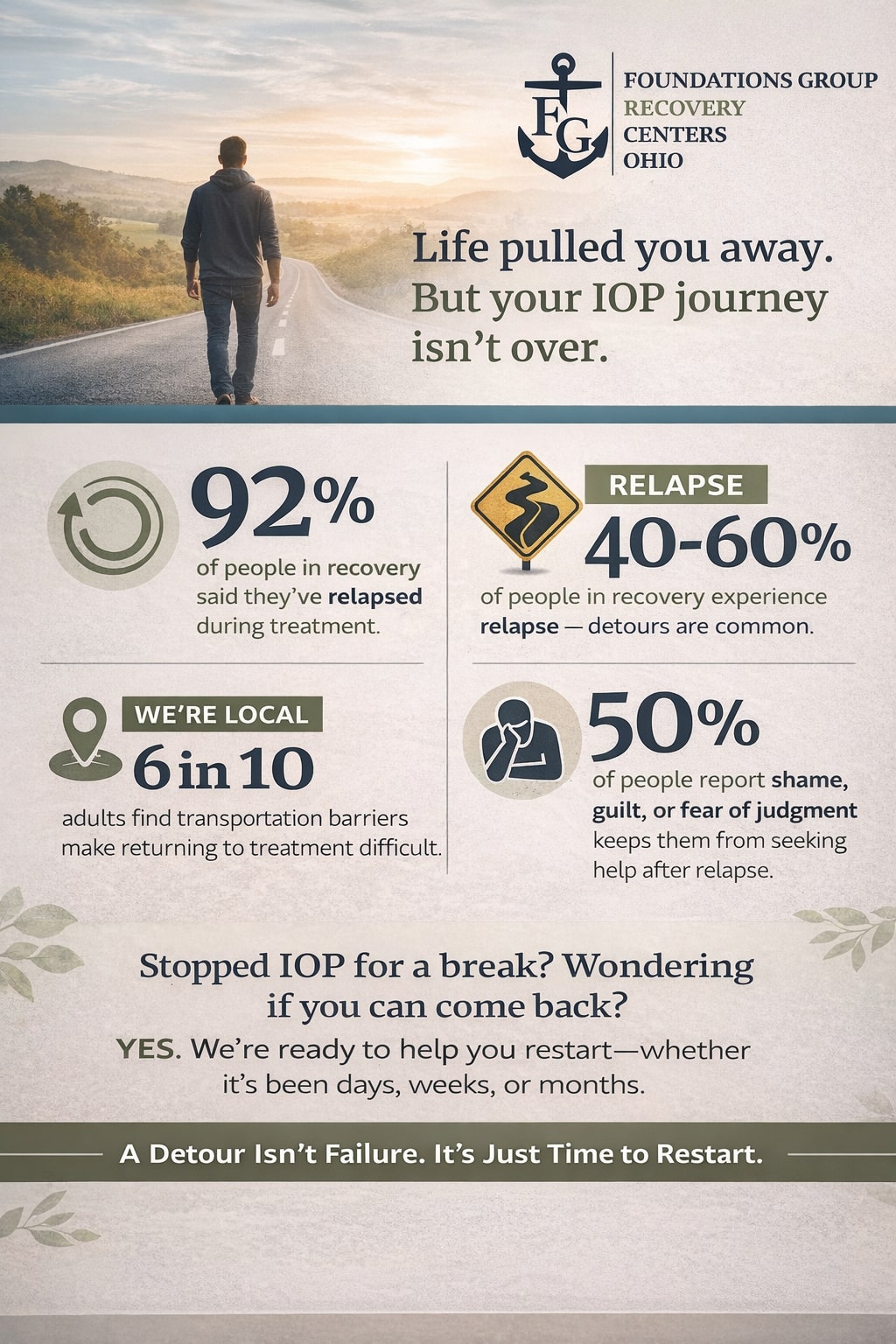
Recovery isn’t a one-lane highway—it’s more like a road trip with detours, flat tires, and lost GPS signals. And that’s okay.
Leaving IOP doesn’t mean you’re not serious about healing. It just means you hit a point where something needed to shift. Restarting is part of the process for many people.
And if you’re even thinking about coming back, that means hope is still alive in you. That’s what matters.
6. Local, Flexible Care You Can Reenter On Your Terms
At Foundations, we serve clients from Upper Arlington and surrounding areas. So whether you’re looking for an intensive outpatient program in Columbus, Ohio or need IOP services closer to home in Franklin County, we’re here.
We also know how to flex with real life. From evening groups to check-ins that work around childcare, we do our best to make care accessible—even when life isn’t simple.
7. What “Coming Back” Might Look Like
Not sure how to even begin re-entering treatment? Here’s a snapshot of how simple it can be:
- Reach out – Call us, email, or use our website form. Even if you just say, “I think I need to come back,” that’s enough to start.
- Mini re-assessment – We’ll check in to see what you need now. That might be a quick conversation or a more formal re-evaluation.
- Restart plan – Together, we’ll decide whether to pick up where you left off or adjust things based on time away.
- First session back – We’ll guide you through it, make sure you’re comfortable, and welcome you back without pressure.
You’re not starting from zero. You’re starting from experience.
8. You’re Allowed to Just Be Curious
Not 100% sure you want to come back? That’s okay too.
You can call us just to ask questions. You can come in for one session and feel it out. You don’t need to be totally “ready.” You just need to be curious enough to ask, “What if I try again?”
9. There’s Still a Seat for You
If you need someone to say it plainly:
Your seat is still here.
Not metaphorically. Literally. The circle of chairs you sat in weeks ago? One still has your name on it.
You’re not an outsider. You’re not a dropout. You’re someone brave enough to try again.
Serving Upper Arlington & Beyond
Whether you’re looking for help in Upper Arlington or need an intensive outpatient program in Franklin County, Ohio, Foundations offers accessible support in your area. You’re not alone—no matter how long it’s been.
FAQ: Restarting IOP After a Break
Is it common to leave and come back to IOP?
Yes. Life happens. Many clients pause for personal, health, or logistical reasons. What matters most is your willingness to return when you’re ready.
Will I be judged or penalized for ghosting the program?
No. We approach every client with compassion. Our focus is on what you need now—not what happened before.
Do I have to start from the beginning if I left mid-program?
Not always. Depending on how long you were gone and what you need, you may be able to continue from where you left off or make small adjustments.
What if I used again while I was gone?
That’s okay. We’re here to help you get back on track. Relapse or return to use is common, and it doesn’t disqualify you from rejoining the program.
How do I get started again?
Call us at (888)501-5618 or visit our IOP program page to reconnect. No pressure, no lectures—just a chance to feel supported again.
📞 Ready to Take One Small Step?
Call (888)501-5618 or visit our intensive outpatient program page to talk to someone who gets it.
You’re not starting over. You’re continuing your story. And we’re ready when you are.