Some people walk into treatment once and stay.
Others walk in, walk out, and wonder if they’re allowed back.
If you’ve paused treatment—or ghosted a program entirely—you’re not the only one. What matters isn’t how long you were gone. What matters is that you’re here, still thinking about change.
At Foundations Group Recovery Center Ohio, we see a lot of brave returns. And often, what helps most the second (or third) time around is a deeper level of structure: a partial hospitalization program (PHP).
You don’t have to start from scratch. You don’t have to explain where you went. You just have to show up—and we’ll meet you there.
You Don’t Have to Start Over to Start Again
Leaving treatment can feel like burning a bridge—but it’s not. Whether you stepped away because of work, overwhelm, relapse, or something you still don’t have words for, you’re still welcome here.
A partial hospitalization program isn’t a punishment or a reset button. It’s a more supportive format that meets you where you are, not where you “should” be.
If intensive outpatient treatment didn’t give you quite enough structure last time, PHP could be a better fit this time—without forcing you to give up your whole life.
PHP Offers More Structure—Without Losing Your Autonomy
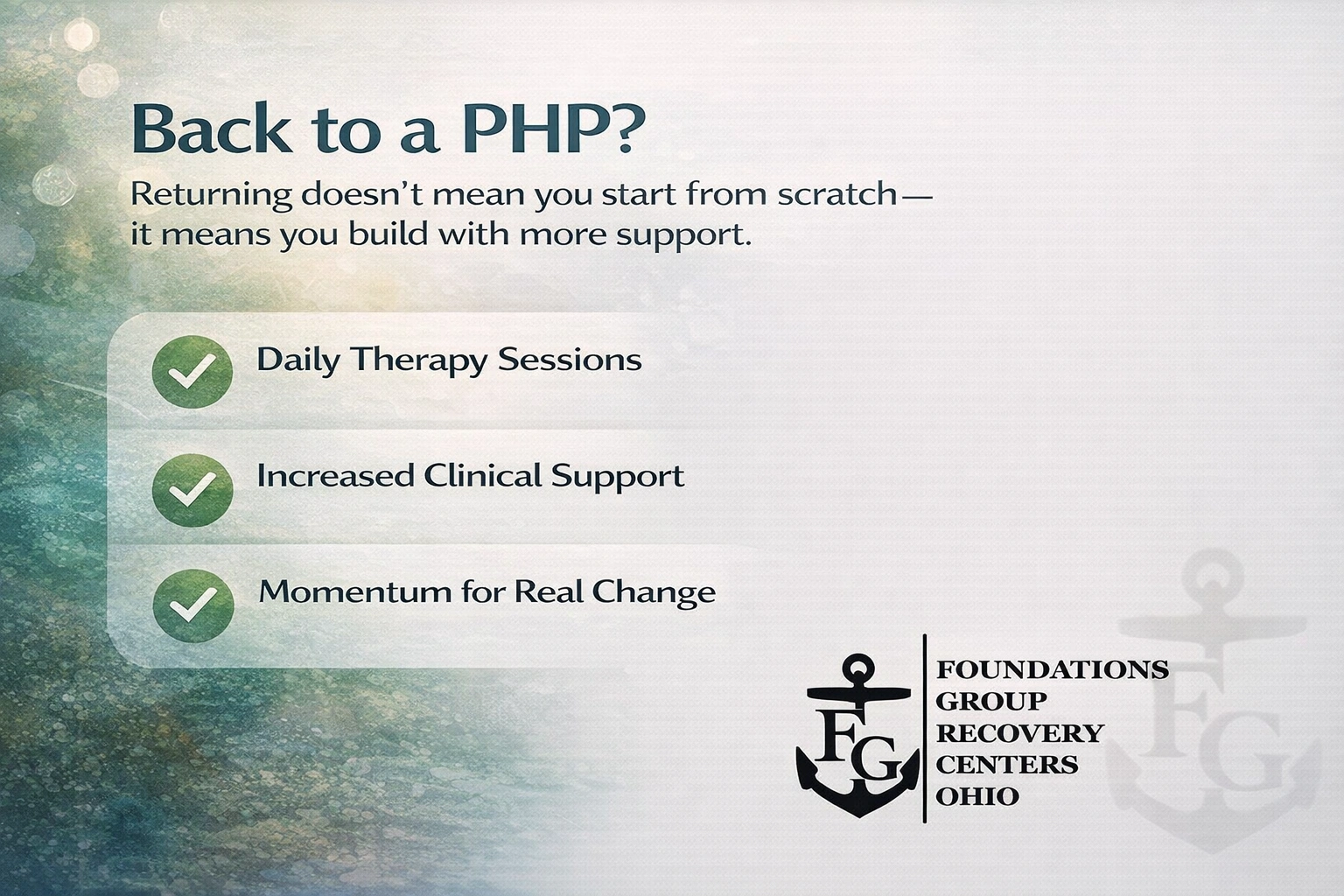
Think of PHP as a middle ground between inpatient and outpatient care. You’ll attend programming most of the day (usually 5 days a week), but you’ll return home in the evenings. You keep your life—but gain enough structure to stabilize it.
Compared to an intensive outpatient program, PHP gives you:
- More time in therapy
- More consistent clinical support
- More momentum when motivation is shaky
And sometimes, momentum is all you need to move forward again.
You Won’t Be Judged for Coming Back
Worried about walking through those doors again? That people will ask where you went? That you’ll have to explain?
You won’t.
Our team understands that stepping away doesn’t mean giving up. It just means you needed space—or didn’t feel ready. We’ve seen people return after a week. A year. Multiple programs. The point is: you’re welcome here, now.
And PHP can help ease the re-entry by giving you more support, not more pressure.
This is especially true for people from Columbus, Ohio, where the pace of life can feel fast, expectations are high, and disappearing quietly is sometimes the only option that feels manageable.
Deeper Support Can Make Recovery Feel Doable
When people leave IOP, it’s rarely because they don’t care. It’s because they’re overwhelmed, under-resourced, or trying to stay afloat with tools that aren’t strong enough yet.
Partial hospitalization fills that gap.
You’ll spend more time building core skills—like how to handle urges, regulate emotions, or rebuild trust without shame. And you’ll do it in a place designed to help you feel safe enough to stay.
What a Typical PHP Day Looks Like
No locked doors. No hospital gowns. Just a clear, steady rhythm.
A typical PHP schedule includes:
- Morning check-in and mindfulness
- Group therapy sessions
- Psychoeducation (learning about patterns, triggers, and tools)
- Individual counseling
- Lunch and connection time
- Afternoon wrap-up and planning
You go home in the evening—with new clarity and new support.
If you need to scale down later, we can step you into an intensive outpatient program that matches your pace. But you don’t have to figure that out now. First, we help you get grounded.
You’re Allowed to Change Your Mind About What You Need
A lot of clients start IOP and realize halfway through: “I actually need more help.” That doesn’t mean they failed. It means they listened to themselves.
There’s no one-size-fits-all timeline. And just because IOP didn’t stick the first time doesn’t mean treatment won’t work for you. It just means you may need something different—more time, more structure, more support.
That’s what PHP offers.
And if you’re coming from Upper Arlington, Ohio, you’ll find that a local, non-residential program like ours helps you stay connected to your responsibilities while still getting the deep work done.
What Makes This Time Different?
Maybe you’re wondering, “How do I know this time will be any different?”
The truth is, we don’t know everything you’re carrying. But here’s what we do know:
- You’re thinking about help again. That means you haven’t given up.
- You’re reading something about structure and support instead of trying to do it all on your own.
- You’re not alone in this—and we’re not here to lecture, punish, or analyze your past. We’re here to build something with you in the present.
This time, you don’t have to walk in pretending to be okay. You can walk in exactly as you are.
FAQ: Partial Hospitalization vs. IOP—Which Is Right for Me?
How is PHP different from IOP?
Both are outpatient programs, but PHP is more intensive. PHP usually involves attending treatment 5 days a week for several hours per day. IOP is typically 3–5 days a week for fewer hours. PHP is ideal if you need more consistent support to stabilize before stepping down to IOP.
Will I have to explain why I left my last program?
Nope. You can share as much or as little as you want. Our focus isn’t on where you’ve been—it’s on where you want to go next. There’s no shaming, no questioning your path, just support moving forward.
Can I switch to IOP later?
Yes. Many people start in PHP and then “step down” into IOP when they’re ready. That transition is built into our programming and happens naturally when you and your treatment team feel you’re ready.
Is PHP right for me if I’m working or parenting?
It depends. PHP is more of a time commitment, so full-time work may be difficult during that period. But if your life allows for it—even temporarily—many clients find that carving out that time upfront allows them to return to work or parenting with more stability, energy, and presence later.
What if I’m nervous about coming back?
Being nervous means you care. It means part of you knows this matters. And it’s okay to feel awkward, unsure, or even scared. What matters most is that you come back anyway. We’ll walk the rest of the way with you.
You’re Not Behind. You’re Still in This.
There’s no scoreboard in recovery. No penalty for leaving. No expiration date on your worth.
Whether it’s been days or months since you last reached out, this could still be the moment things start to shift. You don’t need to feel ready. You just need a place that’s ready for you.
Want to talk through next steps?
Call (888)501-5618 to learn more about our Intensive Outpatient Program in Columbus, Ohio.