If you’re here, something’s already shifted.
You’re not reading about addiction treatment out of curiosity.
You’re reading because whatever you’ve been doing isn’t working anymore.
Maybe you’re drinking more than you want to admit. Maybe you’re spiraling faster than you expected. Or maybe you’re just tired of trying to fix everything yourself.
That first whisper of “I think I need help” is hard to say. Harder to follow. And that’s exactly why understanding what a partial hospitalization program (PHP) is—and isn’t—matters so much.
At Foundations Group Recovery Center, we work with people who know they need help—but don’t want to lose everything to get it. Here’s what to expect from a PHP, why it’s effective, and how it could be the right next step for you.
It’s Not a Hospital—and It’s Not a Lockdown
Despite the name, PHP doesn’t mean a hospital bed or locked doors.
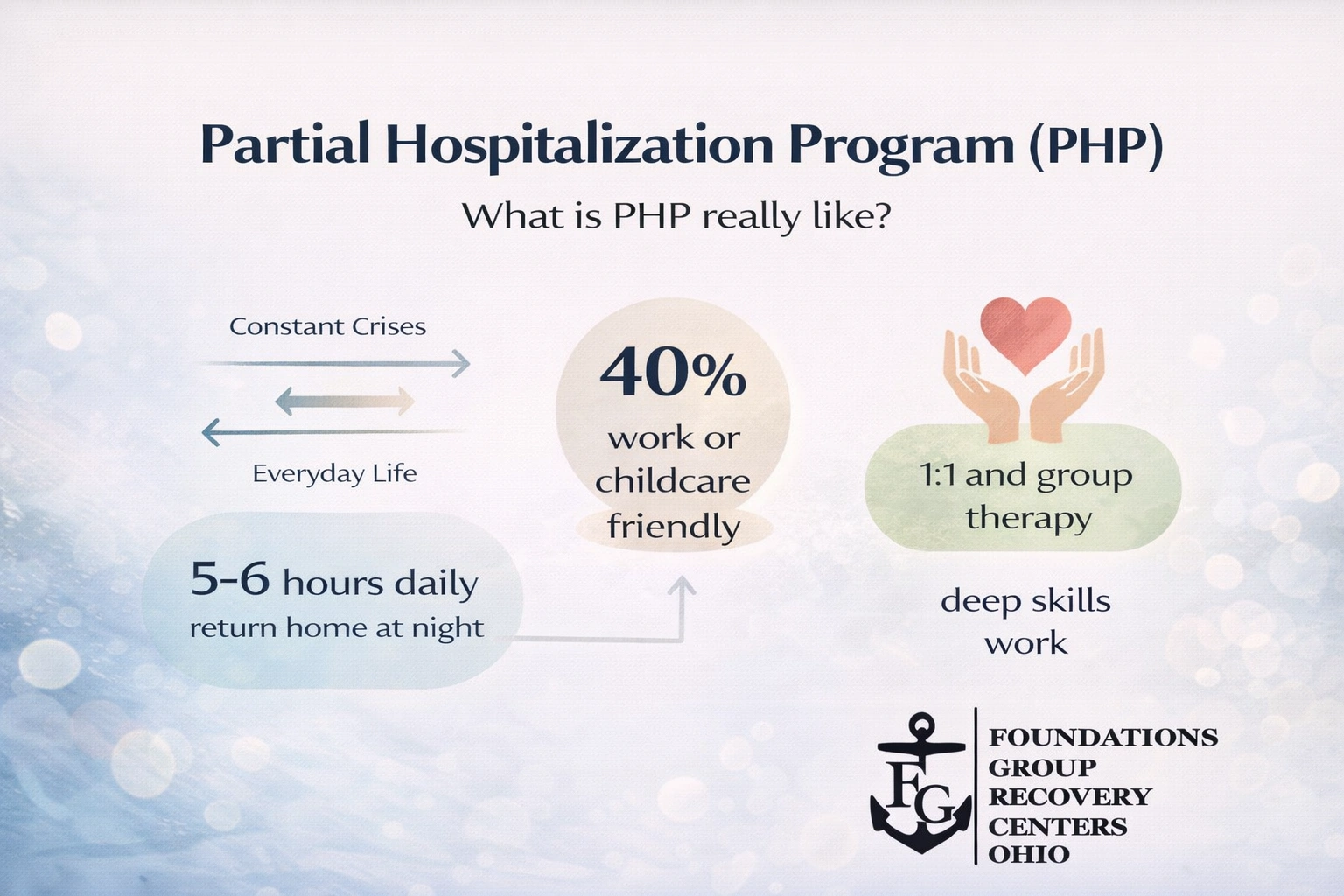
In reality, PHP is outpatient care. That means you go home at night. You wear your own clothes. You keep your phone. You still have your life—you’re just getting serious help while you live it.
PHP is ideal for people who need more support than a weekly therapist can provide, but don’t need 24/7 monitoring in a residential program. You might be struggling with substance use, mental health, or both. You don’t have to have a crisis to qualify. You just have to want something different than the cycle you’re in now.
Your Day Will Be Full, But Focused
In a PHP, treatment typically runs 5–6 hours a day, 5 days a week. It’s immersive—but not overwhelming.
Here’s what a typical day might include:
- Morning check-in and grounding exercises
- Process groups where you talk through emotions, challenges, and progress with peers
- Skills-based groups covering tools for relapse prevention, boundary setting, stress management, and emotion regulation
- Individual therapy to unpack the deeper layers
- Lunch breaks with real conversation and real connection
- Case management support for things like housing, work, or family needs
The structure is part of the healing. It helps your nervous system settle. It helps your mind stop racing. It helps create momentum—so you don’t have to carry the recovery process alone.
You Don’t Have to Be “Sure” Before You Start
Let’s be honest: most people don’t feel ready when they start PHP. They feel scared. Unsure. Defensive. Hopeful. Ashamed. All of it.
That’s normal.
In fact, it’s expected. One of the biggest myths about treatment is that you have to be “ready” to change. In reality, you just have to be open to showing up. The rest comes after.
PHP is designed for people who are in that in-between space. Not in full collapse, but not okay. Not completely lost, but not themselves either.
You’ll Be Surrounded by People Who Understand
You won’t be the only one who’s never done this before. Most clients in PHP are just like you:
Smart. Capable. Struggling silently. Unsure how they ended up here. Unsure how to leave.
What makes PHP powerful is the shared honesty in the room. You’ll hear stories that sound like yours—even if the details are different. That connection matters. Because shame doesn’t survive honest community.
Some people in your group might be dealing with alcohol. Others with anxiety or trauma. Some with both. But no one is here to judge you. Everyone is here to heal something.
You’ll Get Help That’s Bigger Than Just “Stop Using”
This isn’t about taking your drink away and hoping for the best.
In PHP, you learn why the drinking (or using or numbing) became the coping tool. You learn what triggers your spirals. You start to connect dots you’ve never had time or safety to connect before.
You’ll gain skills that last far beyond discharge:
- How to manage cravings without white-knuckling
- How to navigate hard conversations sober
- How to feel without imploding
- How to repair relationships (including the one with yourself)
This is the real work. And you don’t have to do it alone.
The Transition Is Built In
No one stays in PHP forever. It’s a launchpad—not a destination.
When you’re ready, you’ll likely “step down” into an intensive outpatient program (IOP)—fewer hours, more flexibility, same level of care.
You’ll leave with a recovery plan that fits your real life. Whether you’re returning to work, rebuilding trust at home, or figuring out your next chapter—we’ll help you land on your feet.
For many clients in our Partial Hospitalization Program in Upper Arlington, Ohio, that next step comes with more clarity, more stability, and more agency than they thought possible on day one.
FAQ: Partial Hospitalization Program Basics
Do I have to stay overnight?
No. PHP is outpatient. You attend treatment during the day and return home in the evenings.
How long does PHP last?
It depends. Most people stay anywhere from 2–6 weeks. Your treatment team will help you decide when you’re ready to step down to IOP or aftercare.
Can I work while doing PHP?
You’ll likely need to adjust your work schedule temporarily, but some clients work evenings or weekends. PHP is a short-term investment in your long-term stability.
Will people in my life find out?
Only if you choose to tell them. Your treatment is confidential, and we protect your privacy at every step.
Is PHP for mental health or substance use?
Both. Many clients struggle with co-occurring issues. We treat the whole person—not just the diagnosis.
You Don’t Need to Be Sure. You Just Need to Start.
There’s no perfect day to enter treatment. No magic moment of confidence or clarity.
But if you’re here, it means part of you already knows: it’s time.
Still have questions or ready to begin?
Call (888)501-5618 to learn more about our Partial Hospitalization Program in Columbus, OH.