When your child enters a Partial Hospitalization Program (PHP), you may feel like you can finally exhale—but only a little.
For months, maybe years, you’ve been watching your child struggle with alcohol or other substances. The phone calls. The emotional outbursts. The missed opportunities. The late nights wondering if they were safe. When they finally agreed to get help—or needed an intervention to get there—you felt both relief and fear.
Now they’re in treatment. Not inpatient, but not just therapy either. They’re home at night but gone during the day. You’re proud. Hopeful. Still terrified.
At Foundations Group Recovery Center in Upper Arlington, OH, we see this exact emotional terrain every day. We work with families of adult children—most often in their 20s—who are navigating complex, layered dynamics.
This blog is a guide. Not to fix your child. But to support you—the parent—during a time when your role is changing, but still deeply needed.
Learn more about our Partial Hospitalization Program here.
What Is a Partial Hospitalization Program, Really?
It’s natural to feel confused by the term. “Partial hospitalization” sounds intense, maybe even scary. But PHP is actually one of the most effective and flexible treatment levels for adults who need daily, structured care without living in a facility full-time.
At Foundations, our PHP includes:
- Group and individual therapy
- Mental health and psychiatric support
- Substance use counseling
- Life skills and relapse prevention education
- Family support services
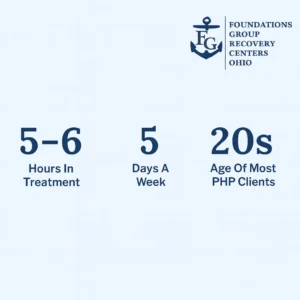
Clients typically attend programming 5 days a week, for 5–6 hours each day. They return home at night to sleep, eat, and rest in familiar surroundings.
This balance allows your child to receive intensive care while remaining integrated in their life—and gives you, as their parent, a unique window of involvement.
Why Your Role Still Matters—Even If They’re Legally an Adult
One of the most emotionally jarring parts of parenting a struggling adult child is the suspension of power.
You can’t legally make decisions for them. You can’t control their treatment. You might not even be able to talk to their providers without a signed release. That lack of access can feel like a wall.
But your role hasn’t disappeared. It’s evolving.
Here’s what remains true:
- You can still be a safe, consistent presence.
- Your relationship still matters to their long-term recovery.
- You’re allowed to have needs, boundaries, and questions.
- Your emotional regulation has ripple effects on their success.
Even when they’re pushing you away, your steadiness is something they still look for. Quietly. Consistently. And often, without saying a word.
What You Can Do to Support (That Doesn’t Involve Fixing)
Support doesn’t mean solving. It means showing up in emotionally intelligent, clear, non-reactive ways.
From our clinicians’ perspective, here are some of the most effective forms of parent support during PHP:
1. Learn, don’t lecture.
Read about what your child is learning in treatment—not to quiz them, but to better understand how to communicate.
2. Create a calm home base.
Many PHP clients return home overstimulated, emotionally raw, or simply exhausted. A quiet, respectful space to decompress helps more than you know.
3. Respect their boundaries—but hold your own.
Don’t push for deep talks after group therapy. But also don’t let your own needs vanish. It’s okay to say, “I’m here if you want to talk—but I also need rest tonight.”
4. Support the schedule.
This might mean helping with rides, meals, or time management. Every small act that removes friction helps your child stay focused on healing.
5. Join family sessions if offered.
This isn’t just for your child’s benefit. These sessions can be healing for you, too. They provide education, emotional processing, and tools for shifting patterns that may go back decades.
What to Expect Emotionally (For You and For Them)
PHP is not a quick fix. It’s a reset.
That reset can be emotional—for both of you. Many parents enter this stage carrying:
- Guilt over past choices
- Resentment over broken trust
- Hope laced with fear
- Exhaustion so deep it feels unspeakable
It’s okay to feel all of this. In fact, it’s expected. What matters is finding places where those feelings can land—whether in your own therapy, a parent support group, or with a trusted clinician.
At the same time, your child may swing between progress and defiance. One day they may be grateful. The next, angry. This is part of the recovery process. It’s not a sign that PHP isn’t working—it’s often a sign that real work is happening.
“I’m Not Sure It’s Working”—What Clinicians Want You to Know
It’s natural to want results. We’ve seen parents panic after just a few days: “They still seem the same. What if this isn’t enough?”
Here’s what we’d tell you:
Change often looks like discomfort before it looks like progress.
When your child stops numbing, they start feeling. That’s painful—and necessary. What looks like resistance is sometimes grief. What sounds like indifference is often fear.
Give it time. Let the clinicians hold the treatment. Let your role be presence, not performance.
And when you’re unsure, ask us. You’re part of this, too.
If you’re looking for a Partial Hospitalization Program in Columbus, Ohio or in Franklin County, our team can guide you through these conversations and questions with care.
FAQs for Parents of Young Adults in PHP
Can I talk to their therapist?
Yes—but only with a signed consent form from your child. Once that’s in place, we can offer updates, collaborate on care, and include you in relevant sessions.
How long does the PHP program last?
Most programs last between 2–4 weeks, but it depends on progress. Some clients step down to IOP after PHP, while others continue with outpatient therapy.
Will they stay sober after this?
PHP is not the end of the road—it’s a launchpad. Ongoing support, connection, and structure will be key. Many families work with us to build a post-PHP support plan.
What if they don’t want me involved?
That’s common. We help rebuild communication and boundaries at a pace that respects both autonomy and connection. Keep showing up—calmly, consistently.
Can I access support for myself?
Yes. We offer family education and can refer you to local or virtual parent support resources. Your healing matters, too.
You’re allowed to feel tired—and hopeful.
Call (888)501-5618 to learn more about our Partial Hospitalization Program services in Upper Arlington, OH.
Your child’s healing matters. So does yours. Let us support both.