You did everything you were told to do.
You found a program. You rearranged your life. You held your breath and hoped.
And now you’re noticing the signs again.
The late nights.
The defensiveness.
The smell you hoped you’d never recognize twice.
If you’re the parent of a 20-year-old who went to outpatient care and is using again, the mix of grief and fear can feel unbearable. As a clinician who has walked alongside many families in this exact place, I want to start here:
This does not mean you failed.
And it does not mean your child is beyond help.
Sometimes, it means the level of care wasn’t strong enough for the level of need.
If you’re trying to understand what stronger support can look like, our team offers alcohol addiction treatment in Ohio designed specifically for young adults who need more structure than weekly sessions can provide.
Let’s walk through this slowly.
Outpatient Can Be a Good Start — But It’s Not Always Enough
Outpatient care often involves therapy sessions a few times per week while your child continues living at home or on campus.
For some people, that’s enough.
But for many 20-year-olds, it’s like asking them to rebuild a house while still standing in a hurricane.
They leave a therapy group at 3 p.m.
By 7 p.m., they’re back with the same friends.
By 10 p.m., the same triggers are in front of them.
Alcohol is woven into college culture, social media, dating, sports events, even simple boredom. Expecting early recovery skills to withstand that constant exposure can be unrealistic.
When relapse happens after outpatient, it’s often not about willingness.
It’s about environment.
Young Adult Brains Are Still Developing
This part matters more than most families realize.
The prefrontal cortex—the part of the brain responsible for impulse control, decision-making, and long-term thinking—continues developing into the mid-20s.
Alcohol directly disrupts that development.
So when you hear, “I’ll just have one,” or “I can handle it now,” you’re not just hearing denial. You’re hearing a brain that is biologically wired for short-term reward.
That doesn’t mean your child doesn’t care.
It means the neurological deck is stacked against them.
More structured care gives the brain time to stabilize without constant chemical interference. And stabilization is often what allows insight to finally stick.
When Drinking Is Covering Something Deeper
In many young adults, alcohol isn’t the core problem.
It’s the coping strategy.
Underneath the drinking, we often find:
- Social anxiety that makes them feel inadequate
- Depression they don’t know how to name
- Trauma they’ve never spoken aloud
- Pressure to succeed
- Shame about not “having it together”
If those issues remain untreated, outpatient sessions can feel like surface work.
More immersive support—whether structured daytime care or live-in treatment—creates space to address both alcohol use and underlying mental health concerns at the same time.
When mental health and substance use collide, intensity of care becomes crucial.
The Guilt Parents Carry (And Why It’s Misplaced)
I hear this every week:
“Did we miss something?”
“Were we too strict?”
“Not strict enough?”
“If we’d acted sooner…”
Here’s the truth: addiction does not emerge because of one parenting decision.
Alcohol is accessible. Socially normalized. Glamorized. And for some brains, highly addictive.
Your child’s struggle is not a referendum on your parenting.
And here’s something I want you to hold onto:
The fact that you are reading this means you are paying attention. That matters.
Signs Your Child May Need More Structure
Every situation is unique. But when outpatient isn’t containing the drinking, families often notice:
- Escalation happens quickly after discharge
- “Just one” turns into blackout episodes
- Therapy attendance becomes inconsistent
- Emotional swings intensify
- Lying or secrecy returns
- Legal or academic consequences reappear
- They seem more agitated than before treatment
Sometimes the biggest sign isn’t on this list.
It’s your gut.
Parents often sense the regression before there’s visible proof. Trust that instinct.
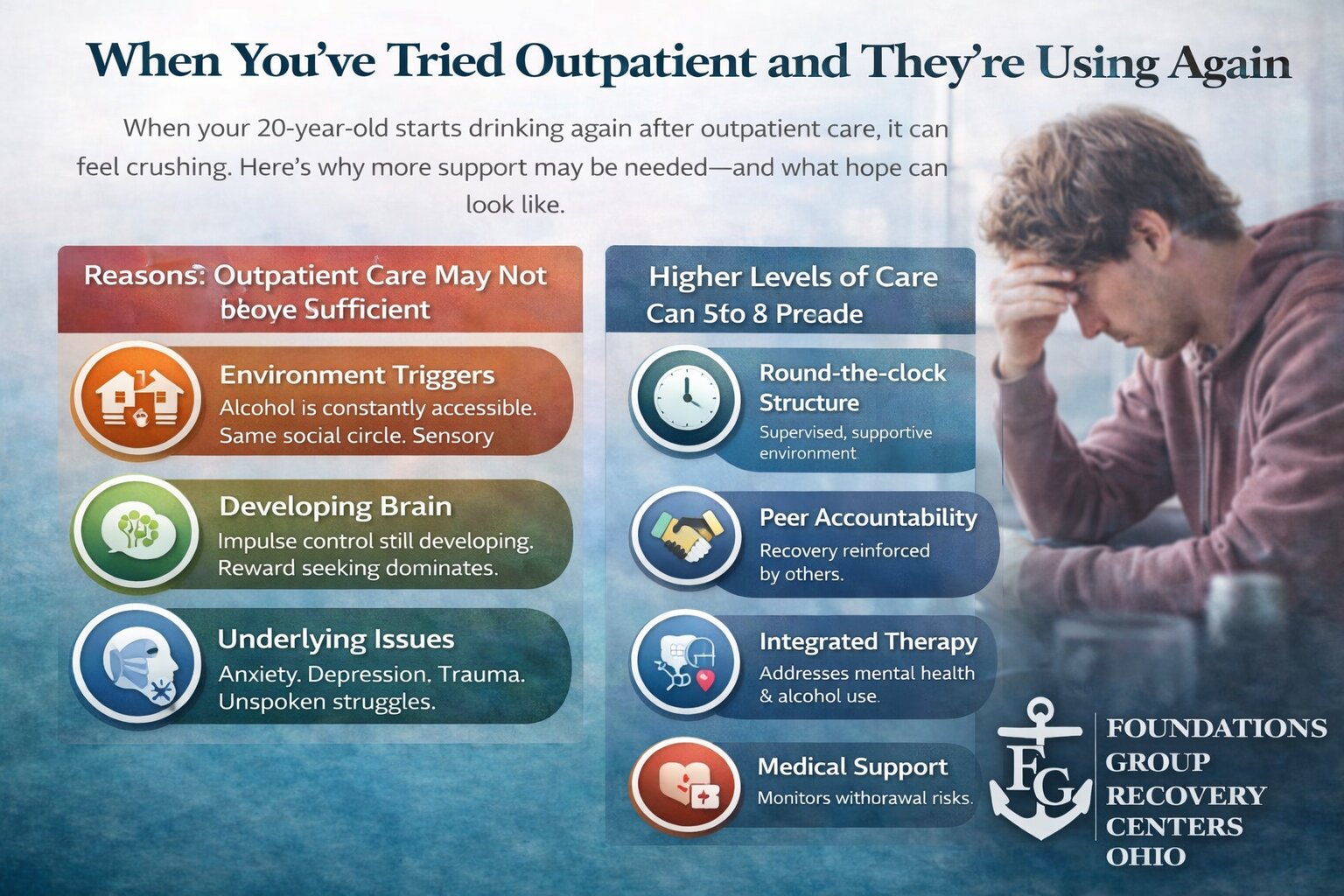
What Higher Levels of Care Actually Provide
When a young adult steps into more structured treatment, several protective factors increase immediately:
1. Environmental Containment
Access to alcohol decreases. High-risk social environments are paused. The nervous system has room to calm.
2. Daily Therapeutic Engagement
Instead of once-a-week sessions, they receive consistent clinical support. Patterns are addressed in real time.
3. Medical Monitoring (When Needed)
Withdrawal risks, sleep disturbances, and mood instability are managed safely.
4. Peer Accountability
Recovery is reinforced by others in the same stage of life. Isolation decreases.
5. Integrated Mental Health Care
Anxiety, depression, trauma, and self-esteem issues are treated alongside alcohol use.
This kind of containment doesn’t punish.
It stabilizes.
And stabilization is often what prevents years of cycling.
“But Won’t More Treatment Push Them Away?”
This fear is real.
Parents worry:
If we push too hard, they’ll cut us off.
If we insist, they’ll resent us.
There is no perfect script.
But here’s what we know clinically: untreated addiction pushes families apart far more aggressively than structured treatment does.
Conversations don’t have to be threats. They can be invitations rooted in concern:
“We love you. We see you struggling. And we believe you deserve stronger support.”
Young adults often resist at first. Many later say they’re grateful someone intervened before things got worse.
Relapse Is Information, Not a Verdict
If your child used again after outpatient, that is not a life sentence.
Relapse tells us:
- The trigger load was too high
- Coping skills weren’t fully integrated
- Underlying pain wasn’t fully processed
- Or the level of care wasn’t sufficient
In medicine, when a treatment plan doesn’t produce stability, we adjust the plan.
Addiction deserves the same clinical mindset.
Not shame. Adjustment.
Frequently Asked Questions
How do I know if outpatient truly “failed”?
Outpatient doesn’t fail. It serves a specific level of need. If your child returned to heavy or risky drinking quickly, it may simply indicate that a higher level of structure is required.
Is live-in treatment the only next step?
Not always. Some young adults benefit from structured daytime programs that provide several hours of therapy multiple days a week. Others need round-the-clock support temporarily. The right fit depends on severity, safety, and mental health factors.
What if my child refuses to go?
Resistance is common. Conversations often take multiple attempts. Consulting with professionals about how to approach the discussion can help reduce escalation and increase cooperation.
Is it too early to consider stronger care?
Early intervention is protective. Waiting for “rock bottom” often leads to greater harm. If you’re seeing patterns re-emerge, it’s reasonable to reassess now.
Will this affect their future permanently?
Untreated addiction carries far greater long-term consequences than receiving structured treatment. Stabilizing now can preserve academic, career, and relational futures.
What if I’m emotionally exhausted?
You are allowed to be tired. Supporting a child in active addiction is draining. Parent support groups and family therapy can provide relief and clarity. You deserve care too.
There Is Still Hope Here
I have worked with countless families who sat in my office convinced it was too late.
It wasn’t.
Young adults are remarkably resilient when the right structure is in place. The brain can heal. Patterns can change. Insight can grow.
The window is not closed.
If you are questioning whether a stronger level of alcohol addiction treatment is needed, that question itself is protective. It means you are watching closely. It means you care enough to intervene.
And that kind of love changes outcomes.
You don’t have to navigate this alone. Call (888)501-5618 or visit our Alcohol addiction treatment services in Columbus to learn more about next steps.