If I stop drinking… will I still be me?
That question surfaces more than people realize—softly spoken in therapy sessions, written between the lines of intake forms, or asked out loud with a nervous laugh.
It’s a fear that lives in creative people, especially those who’ve tied their art, identity, or emotional access to alcohol.
At Foundations Group Recovery Center in Upper Arlington, we’ve worked with painters, musicians, actors, social butterflies, empaths—the feel-everything people who aren’t just worried about getting sober. They’re scared of becoming someone else.
What if I lose my edge?
What if sobriety dulls my senses?
What if I can’t create without it?
We hear you. And we want to offer something better than a clinical answer—we want to offer truth with hope.
If this sounds like you, or someone you love, our alcohol addiction treatment program in Ohio is built to support not just recovery, but identity restoration.
“I Only Write When I’m Drinking”: When Alcohol Becomes a Creative Tool
Many creatives don’t drink to escape. They drink to access.
Alcohol can feel like a key—opening doors to big ideas, bold feelings, uninhibited expression. That glass of wine while painting. That bourbon before open mic. That six-pack while mixing beats or sketching late at night.
It starts small and almost romantic. But over time, that key starts locking doors, too.
You need more to get the same spark. You forget what you wrote last night. You start skipping sessions, shows, or rehearsals. And one day, you realize the bottle isn’t helping you write—it’s stopping you from living.
What Clinicians See: Alcohol Doesn’t Fuel Creativity. It Hacks Your Inhibitions.
From a treatment perspective, alcohol isn’t a creativity booster—it’s a neurological disinhibitor. That means it reduces your brain’s natural filter, making you feel looser, freer, less self-conscious.
And yes, that can make early writing or creating feel easier. But what we see in long-term alcohol addiction treatment is this:
- The early rush wears off
- Emotional processing becomes harder
- Cognitive function declines (memory, attention, clarity)
- Creative output becomes chaotic or inconsistent
Clients often tell us, “I used to feel more creative drunk, but now I can’t even focus enough to finish something.”
That shift isn’t just in your head. It’s in your brain chemistry, your liver function, your sleep cycles—all of which alcohol quietly disrupts, even before a person hits what most would call “rock bottom.”
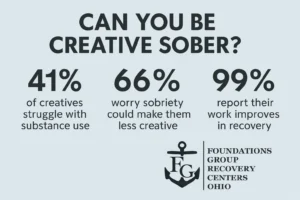
“But I’m Afraid Sobriety Will Flatten Me”
Let’s name it clearly: if alcohol helped you feel more open, it makes sense to fear losing that version of yourself.
One of the hardest parts of early recovery for creative, high-emotion people is this fear:
What if I get sober… and get boring?
What if I lose my edge, my flow, my charm?
What if I’m just blank without it?
It’s not a silly fear. It’s a real one, rooted in lived experience. For many, alcohol felt like the only path to feeling anything big or saying something true.
We don’t dismiss that. But we do gently challenge the myth that your brilliance came from the bottle.
Here’s what we’ve seen in recovery rooms, therapy sessions, and alumni check-ins at Foundations:
- The poet who found her real voice after 30 days of clarity
- The painter who reconnected with color when his hands stopped shaking
- The musician who rebuilt his sound—fuller, richer, more honest—without a single shot of whiskey
Alcohol doesn’t create your voice. It just distorts the channel.
Sobriety Isn’t Silence—It’s a Different Kind of Sound
There’s a metaphor we use sometimes:
If alcohol is an amplifier, sobriety is a tuning fork.
It doesn’t make your voice louder. It helps you find your true note.
In treatment, we often see people rediscover their creativity—not as a product of intoxication, but as a function of healing. They write with more emotional depth. They paint with steadier hands. They feel more connected to their work—not just during it, but after.
Sobriety isn’t the absence of emotion. It’s the full permission to feel and remember—and create from that place with clarity.
But What About Social Confidence?
This is another identity fear that comes up, especially for creatives who thrive in social settings or performance spaces.
Alcohol helped you feel bold. It let you own the room. Now you’re wondering: who will I be without it?
Here’s what recovery helps people uncover:
- That the confidence wasn’t fake—it was buried.
- That performance anxiety can be managed without numbing.
- That you’re still funny, talented, warm, magnetic—without a drink in your hand.
Social discomfort in early sobriety is normal. But it passes. And in its place, we often see deeper connections form. Real laughter. Shared moments remembered the next day. Confidence not tied to a buzz—but to presence.
What Alcohol Addiction Treatment Actually Offers
At Foundations Group Recovery Center, alcohol addiction treatment in Upper Arlington isn’t about stripping you of identity. It’s about protecting the parts of you that got blurred, buried, or bruised along the way.
Our clinicians understand emotional depth. Many of us are creatives too. We don’t pathologize your fear—we help you move through it.
Services include:
- Trauma-informed therapy
- Identity and self-concept work
- Group sessions for expressive processing
- Dual diagnosis support if anxiety, depression, or bipolar symptoms are involved
- Aftercare planning that keeps your creative life intact
We also support people looking for alcohol addiction treatment in Columbus, Ohio and across Franklin County, with flexible programs that allow space for healing and rebuilding.
You’re Allowed to Miss the Version of You That Drank
Grief is part of recovery.
Even if the drinking version of you made mistakes, even if they were struggling—that version might have felt more alive. More vibrant. More you.
That doesn’t mean sobriety will erase you. It means you’re allowed to grieve while discovering what’s real underneath.
At Foundations, we don’t rush that process. We walk it with you.
Because here’s the quiet truth: your creative fire doesn’t live in a bottle. It lives in your story. And you’re not done telling it yet.
FAQs: Alcohol Addiction Treatment & Creative Identity
Will treatment make me feel emotionally flat?
In the early days, yes—it’s possible to feel emotionally off or muted. That’s part of the brain recalibrating. But with time (and support), emotional depth not only returns—it often becomes richer and more grounded.
What if I’ve only ever created while drinking?
You’re not alone. Many clients say the same. Part of treatment includes exploring creative practices sober—and you might be surprised how much more connected you feel to your work once your mind and body begin healing.
Can I still be in creative spaces while in recovery?
Yes. Boundaries may shift, but we work with you to build a life that includes your creative passions—not one that removes them.
What does a typical alcohol addiction treatment program involve?
Treatment often includes individual therapy, group support, skills building, and sometimes medication management—depending on your needs. At Foundations, we tailor care plans to your lifestyle, values, and identity goals.
I don’t feel “addicted,” but I’m worried about my drinking. Can I still reach out?
Absolutely. You don’t need to hit a rock bottom to get support. If alcohol is starting to feel like it’s costing more than it’s giving—that’s enough reason to talk to someone.
Want to talk it through?
You don’t have to decide anything today. But if you’re wondering who you’ll be without alcohol—and want someone who gets it—Foundations Group Recovery Center is here.
Call (888) 501-5618 or visit the link above to learn more about our alcohol addiction treatment services in Upper Arlington, OH. Your creativity isn’t gone. It’s just waiting for air.