I didn’t walk out of treatment feeling “cured.” I walked out hopeful and scared, carrying a sobriety chip in my pocket like it might ward off every craving. I thought maybe I’d beat it this time.
I didn’t.
But what I didn’t expect—what no one told me—is that the relapse wasn’t the end. It was different this time. Because alcohol addiction treatment didn’t prevent me from falling—but it completely changed how I landed.
Foundations Group Recovery Center in Ohio didn’t promise me a finish line. They gave me something much more useful: tools to rebuild, even when I messed up.
The First Slip Wasn’t Dramatic—But It Shook Me
It didn’t look like a movie scene. I didn’t throw away months of sobriety in a bar with a shot glass in hand.
It was one drink. Quiet. Alone. A moment I convinced myself didn’t count.
But the moment that drink hit my lips, shame came rushing back like a freight train. The voice in my head was brutal:
“You’ve ruined everything.”
“You’re exactly who you were before.”
“Treatment was a waste.”
That spiral used to keep me down for months. This time, it didn’t.
What I Got From Treatment That I Didn’t Appreciate at First
When I was in group, I’ll be honest—I rolled my eyes a lot. I didn’t want to “share feelings.” I didn’t want to talk about my inner child. I thought I just needed discipline.
But when the relapse happened, those tools were the only thing between me and a full-blown tailspin.
- I remembered how to pause instead of numb.
- I remembered how to call someone instead of isolate.
- I remembered that I wasn’t the only one who’d been here before.
Treatment didn’t change my urges. It changed my instincts.
Relapse Doesn’t Mean You Wasted Your Shot
This is the lie addiction loves most: that once you fall, it’s over. That the work you did doesn’t count.
Here’s the truth: relapse doesn’t reset your worth. It doesn’t cancel your effort. What matters is what happens next.
And what happened next, for me, was different than it had ever been.
I didn’t ghost my sober friends. I didn’t disappear into shame. I didn’t drink for six more months pretending I was fine.
I made one call. Then another. Then I walked back into a meeting with my head down—and walked out with it a little higher.
A New Definition of Recovery
People love to talk about milestones. 30 days. 90 days. One year sober. Those moments matter—but they’re not the whole story.
Recovery isn’t a perfect streak. It’s not a shiny number. It’s the decision to return to yourself, even after you’ve walked away for a while.
And that’s what treatment helped me see: recovery wasn’t over just because I relapsed. It had just entered a harder chapter.
One I was finally equipped to write.
If You’ve Been Through Treatment and Still Slipped—You’re Not Alone
I used to believe I was the only one who’d walked out of rehab and still drank again. That belief almost kept me from trying again.
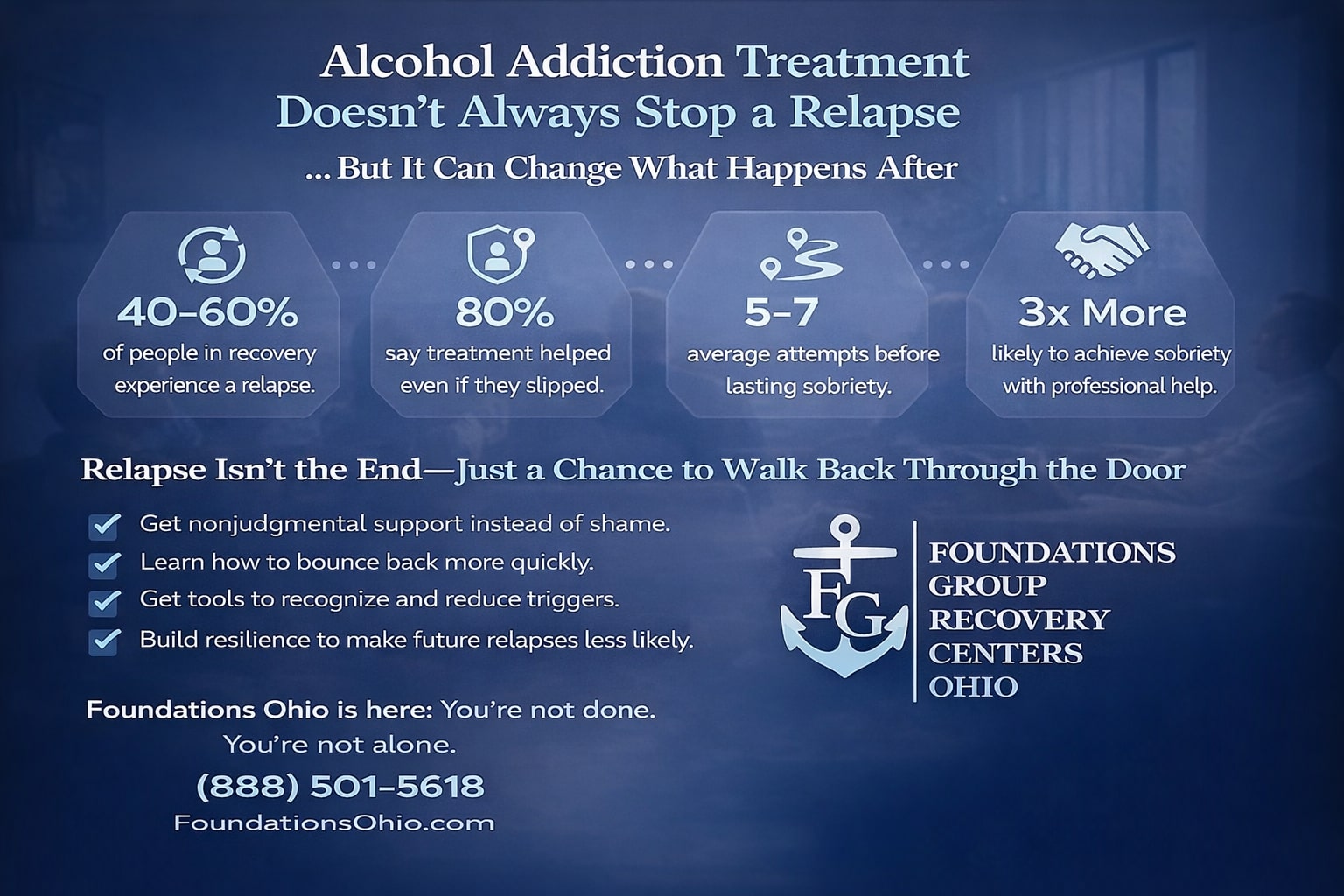
But the truth is, many people relapse. What matters isn’t the slip. It’s the support you have afterward.
Alcohol addiction treatment at Foundations Ohio isn’t about punishing relapse. It’s about changing your relationship with it.
It taught me how to recognize triggers. How to speak up before the spiral. How to forgive myself faster, with more grace, and less drama.
That changes everything.
You Don’t Have to Believe in Recovery to Take the Next Step
If you’re skeptical about treatment because it didn’t “work” the first time—I see you. I was you.
Maybe you’re thinking:
“Why would this time be any different?”
“What if I disappoint everyone again?”
“What if I disappoint myself?”
Here’s the only answer I can give you:
You’re allowed to try again. Not because you failed—but because you’re still alive. Still here. Still reaching for something better, even if your grip is shaky.
That matters more than you know.
Real Talk: Alcohol Addiction Treatment Isn’t a Cure—But It’s a Shift
No one handed me a solution in treatment. They handed me a mirror, a pen, a phone list, and a bunch of phrases I thought were cheesy until they saved me:
“Progress, not perfection.”
“One day at a time.”
“You only have to change one thing—everything.”
You can roll your eyes. I did. But when the time came, those words were the rope I pulled myself up with.
So no—alcohol addiction treatment didn’t stop my relapse.
But it did make sure that my relapse didn’t stop me.
Alcohol Addiction Treatment in Ohio: Find Your Next Step
If you’re in Ohio and wondering whether it’s worth trying again, this is your sign: it is. Even if you’ve tried before. Even if you’re not sure it’ll work.
Foundations Group Recovery Center offers alcohol addiction treatment in Ohio that understands relapse isn’t failure—it’s feedback.
📍 Explore more about your treatment options in Ohio if you’re ready for something different this time. Whether you’re in Columbus, Franklin County, Upper Arlington, Foundations Ohio is nearby and ready to help.
📞 Or call (888) 501-5618 to talk to someone who gets it.
FAQ: Alcohol Addiction Treatment and Relapse
Does relapse mean treatment didn’t work?
Not necessarily. Relapse can be part of recovery for many people. It doesn’t erase the progress you made—it just means you may need more support, new tools, or deeper healing.
Can I go back to treatment after relapsing?
Yes. Most programs—including Foundations—welcome people back without judgment. Recovery isn’t linear. Coming back is a sign of strength, not failure.
What should I do after a relapse?
Take a breath. Don’t let shame steer the ship. Reach out to someone safe—a sponsor, therapist, friend, or treatment center. You don’t need to fix everything today. Just reconnect.
Is alcohol addiction treatment different if I’ve been before?
It can be. Good treatment centers will meet you where you are, not where they think you should be. They’ll build on what you’ve already learned and help you find what’s still missing.
What if I don’t think I can do it again?
Then just take one small step. Call. Ask a question. Visit a website. You don’t have to believe in full recovery yet. Just believe that trying again is still worth it.