You haven’t missed a deadline.
You haven’t embarrassed yourself publicly.
Your life still looks intact.
But every night, the relief you reach for is starting to feel less like a choice and more like a requirement.
As a clinician, I work with executives, healthcare providers, business owners, parents, and high-level professionals across Ohio who maintained impressive lives while privately unraveling. Many of them considered alcohol addiction treatment long before they ever made the call.
The delay isn’t about ignorance.
It’s about identity.
It’s about fear.
It’s about control.
Let’s pull back the curtain.
Success Becomes the Perfect Hiding Place
High achievement is protective camouflage.
If you’re still earning, parenting, leading, and producing—who questions your drinking?
Performance becomes proof that nothing is wrong.
But here’s what I see behind closed doors:
- You plan meetings around recovery time.
- You avoid morning calls because you’re not steady yet.
- You overprepare because your focus isn’t as sharp.
- You feel a flicker of panic when alcohol isn’t available.
You’re compensating constantly.
High-functioning drinkers don’t collapse outwardly. They erode inwardly.
The world sees stability.
You feel strain.
The Internal Math Never Stops
You likely don’t wake up thinking, “I have a problem.”
You wake up thinking:
- “I’ll cut back this week.”
- “Only wine, not liquor.”
- “Not tonight.”
- “Just one.”
By 9 p.m., the rules shift.
Then tomorrow, you renegotiate again.
This constant internal bargaining drains more energy than most people realize. Your brain is always calculating:
How much is left?
Is this too much?
Did anyone notice?
Can I function tomorrow?
That’s not freedom. That’s mental taxation.
And high achievers tolerate that tax for years.
You’re Afraid of Losing the Edge
This is the fear few people say out loud.
Alcohol may feel like:
- Your social lubricant
- Your reward system
- Your off-switch
- Your creative spark
- Your way to tolerate pressure
If you remove it, what happens to your sharpness? Your charisma? Your productivity?
High-performing professionals often tell me, quietly:
“I’m scared I’ll lose my drive.”
“I don’t know how to relax without it.”
“What if I become… flat?”
This isn’t vanity. It’s fear of identity loss.
But here’s the clinical reality: dependence doesn’t sharpen you long-term. It narrows you. It dulls sleep, disrupts focus, destabilizes mood, and gradually shrinks emotional range.
You don’t lose your edge in recovery.
You regain your clarity.
You Don’t Relate to “Rock Bottom”
You’re not waking up in a jail cell.
You’re not losing custody.
You’re not sleeping on couches.
So you assume your situation doesn’t qualify.
High-functioning alcohol misuse often lacks dramatic consequences—at least early on. Instead, it shows up as:
- Chronic exhaustion
- Irritability at home
- Anxiety that wasn’t there before
- Blood pressure creeping up
- Emotional distance from people you love
- A quiet sense of fraudulence
You’re succeeding publicly while privately asking, “How long can I keep this up?”
Rock bottom is not a requirement for change.
Exhaustion is enough.
The Fear of Exposure Is Paralyzing
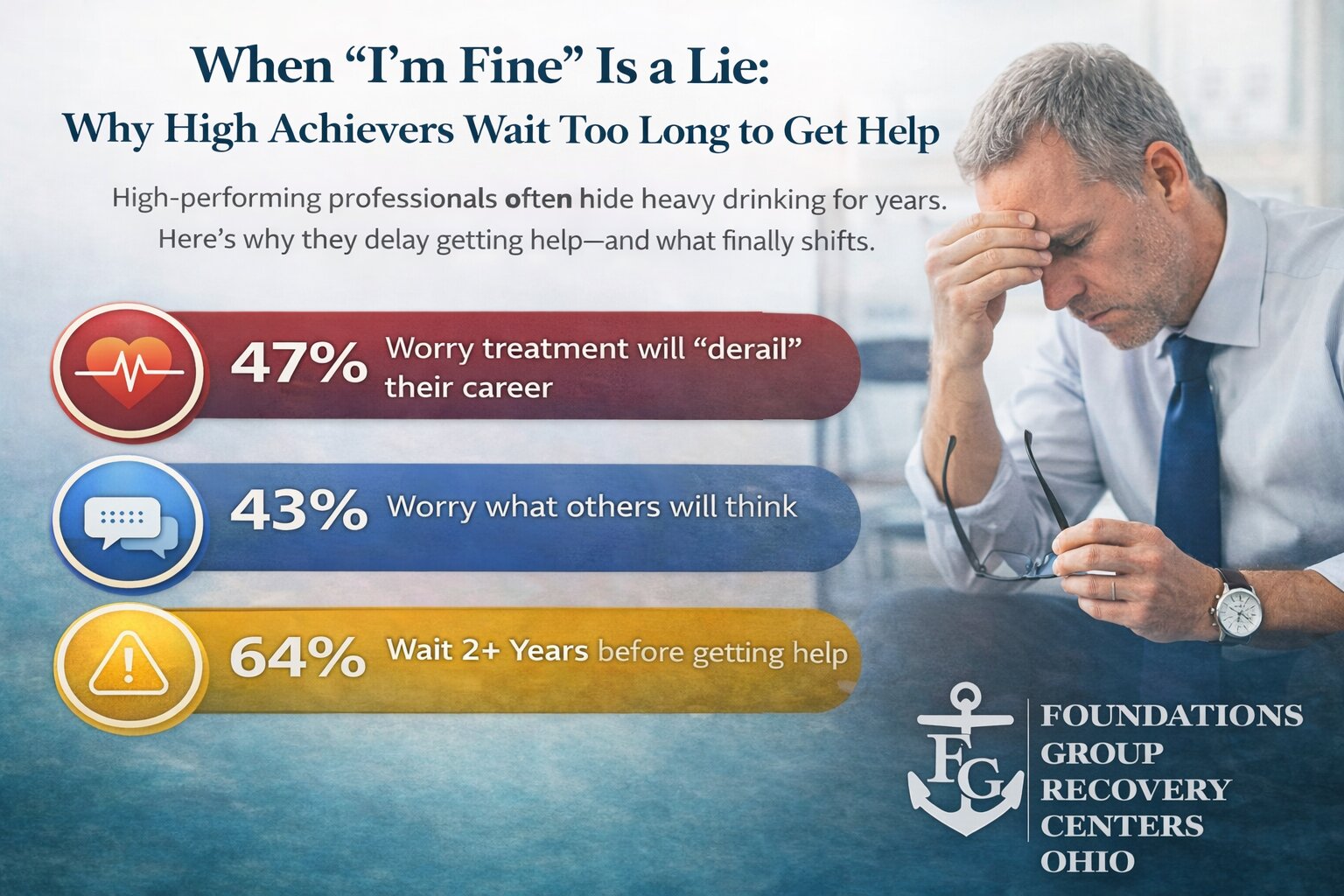
Professionals delay treatment because they imagine worst-case scenarios:
- “What will my colleagues think?”
- “Will this impact my license?”
- “Will my family see me differently?”
- “Will I disappear from my life?”
That fear keeps people stuck longer than the drinking itself.
In reality, treatment today is adaptable. Some people step into live-in care when they need full stabilization. Others enter structured daytime care or multi-day weekly treatment while continuing work and family life.
It is not one-size-fits-all.
It is not public humiliation.
It is not a collapse of your reputation.
It’s medical and psychological support for something that is treatable.
And for many high-functioning professionals, Alcohol addiction treatment becomes the first place they finally stop pretending.
High Functioning Doesn’t Mean Low Risk
I need to be direct here.
Chronic heavy drinking—no matter how polished your life looks—carries risk:
- Liver damage
- Cardiovascular strain
- Cognitive decline
- Increased anxiety and depression
- Escalation over time
Tolerance builds. What worked three years ago doesn’t work now.
High achievers are especially vulnerable to gradual escalation because stress remains constant. Alcohol becomes the predictable regulator.
But stress + alcohol + sleep disruption creates a long-term physiological spiral.
You may be managing today.
Your body is keeping score.
The Cost of Waiting Is Usually Emotional
Most high-functioning clients don’t come in because they “hit bottom.”
They come in because they’re tired of:
- Hiding bottles
- Deleting evidence
- Waking up at 3 a.m. anxious
- Snapping at their kids
- Feeling like an imposter
- Knowing they’re not operating at full capacity
One executive told me:
“I wasn’t out of control. I just wasn’t fully alive.”
That sentence stays with me.
Because that’s the quiet cost. Not catastrophe—contraction.
Your world slowly shrinks around the substance.
What Actually Changes When You Stop Waiting
Not your intelligence.
Not your drive.
Not your ambition.
What changes is the background noise.
You stop calculating.
You stop hiding.
You stop planning around the next drink.
You sleep deeper.
You think clearer.
Many high performers are shocked at how much mental bandwidth returns.
Recovery doesn’t flatten personality. It removes the constant interference.
And when alcohol no longer runs the evening, your capacity expands in ways that surprise you.
FAQ: High-Functioning Drinking & Getting Help
“If I’m still successful, do I really need help?”
Success does not cancel out dependency. If alcohol feels necessary rather than optional, if cutting back feels harder than it should, or if you’re constantly negotiating with yourself—that’s worth examining.
You don’t have to lose everything to justify support.
“Will treatment force me to stop working?”
Not necessarily. Levels of care vary based on clinical need. Some individuals require live-in stabilization. Others participate in structured daytime or multi-day weekly programming while maintaining professional responsibilities.
The goal is stabilization—not disruption.
“What if I try and it doesn’t work?”
Many high achievers worry about “failing” at recovery the way they would a business venture.
Treatment isn’t pass/fail. It’s adaptive. If something doesn’t work, it adjusts. Progress is not linear, and support systems evolve around you.
“I’m afraid people will find out.”
Confidentiality is protected. Treatment centers operate under strict privacy laws. Seeking help is a medical decision, not a public announcement.
Most people are far more discreet than you imagine.
“What if alcohol is the only thing helping me cope with stress?”
It may feel that way.
But alcohol ultimately worsens sleep, anxiety, and stress tolerance over time. Treatment addresses the underlying stress patterns, not just the drinking behavior.
You deserve coping mechanisms that don’t slowly cost you your health.
“How do I know it’s time?”
If you’re reading this and feeling seen, that’s information.
If you’ve Googled your drinking more than once, that’s information.
If you’ve promised yourself you’d cut back and haven’t, that’s information.
You don’t need disaster to make a decision.
You Don’t Have to Crash to Change
The myth is that successful people can’t have serious problems.
The truth is they just hide them better.
If you’re functioning but not okay, that matters.
If you’re maintaining but exhausted, that matters.
If alcohol is quietly narrowing your life, that matters.
You have built something meaningful. It deserves protection—not erosion.
Call (888)501-5618 or visit our Alcohol addiction treatment services in Ohio to learn more about our Alcohol addiction treatment services in Upper Arlington.