
I didn’t look like someone who needed help.
That’s what made it so easy to ignore.
I had a job I showed up to every day. I answered emails. I met deadlines. I made plans and kept them. If you looked at my life from the outside, it all held together.
So I told myself the same thing, on repeat:
It’s not that bad.
And the truth is—I believed it.
If you’re reading this, you probably understand that version of yourself. The one who keeps everything moving. The one who doesn’t fall apart in obvious ways. The one who convinces everyone—including yourself—that you’ve got it handled.
But something in you also knows there’s more to the story.
If you’ve started questioning that quiet tension underneath it all, looking into something like flexible treatment that fits your schedule might not be as extreme as it sounds. For me, it was the first step that didn’t feel like losing my life—it felt like getting it back.
I Was Holding It Together—But Barely
“High-functioning” is a strange label.
It sounds like a compliment.
But what it really meant for me was this:
I was surviving in public and struggling in private.
No one saw:
- How drained I felt at the end of every day
- How much effort it took to keep everything looking normal
- How often I told myself just get through today
I wasn’t falling apart.
But I wasn’t okay either.
And that space in between? It’s exhausting.
The Constant Background Noise
What people don’t see is the mental load.
It wasn’t just drinking. It was thinking about drinking.
Planning it. Justifying it. Negotiating with myself about it.
I’d sit at work thinking:
- I won’t tonight
- Okay, maybe just one
- Actually, I deserve it today
That loop never stopped.
Even on days I didn’t drink, it was still there—taking up space, draining energy.
And I kept telling myself:
If I’m still in control, it’s fine.
But control shouldn’t feel like a full-time job.
The Way I Kept Moving the Line
This part is hard to admit.
What counted as “too much” kept changing.
Things I once would’ve questioned became normal.
Things that used to concern me became explainable.
I’d say:
- It’s just stress
- It’s been a long week
- Everyone does this
And maybe they do.
But not everyone feels like they’re quietly losing ground while trying to look stable.
That was the difference.
Why I Didn’t Want to Ask for Help
I had this idea in my head of what getting help meant.
It meant stepping away from everything.
It meant losing control of my schedule.
It meant people finding out.
And I wasn’t ready for any of that.
So I stayed where I was.
Even when I started looking things up, I got stuck comparing options like outpatient vs inpatient rehab—as if those were the only two choices.
One felt like too much.
The other felt like not enough.
So I did nothing.
That’s the trap.
The Moment That Broke Through My Denial
It wasn’t dramatic.
No big consequence. No crisis.
Just a quiet realization one night:
I don’t actually feel in control of this anymore.
That thought didn’t come with panic.
It came with clarity.
And once I saw it, I couldn’t unsee it.
That was the moment everything shifted—not because things got worse, but because I finally stopped minimizing them.
Starting Without Disappearing
I didn’t want my life to stop.
I just wanted it to feel different.
So I looked for something that fit into my life instead of replacing it.
Multi-day weekly support. A consistent schedule. Real conversations.
It wasn’t overwhelming. It wasn’t isolating.
It was… doable.
And that mattered more than anything.
Because I could:
- Keep working
- Stay connected to my responsibilities
- Actually deal with what I’d been avoiding
It didn’t feel like punishment.
It felt like relief I didn’t know I needed.
What Actually Changed Once I Stopped Pretending
I expected judgment.
I expected pressure.
What I got instead was space.
Space to:
- Be honest without explaining everything perfectly
- Say “I’m not okay” without it turning into a crisis
- Understand why I kept ending up in the same place
And slowly, things shifted.
Not overnight.
But enough to notice.
The constant tension eased.
The mental noise quieted.
I didn’t feel like I was holding everything together by force anymore.
Why “High-Functioning” Isn’t the Whole Story
Here’s the truth I avoided for a long time:
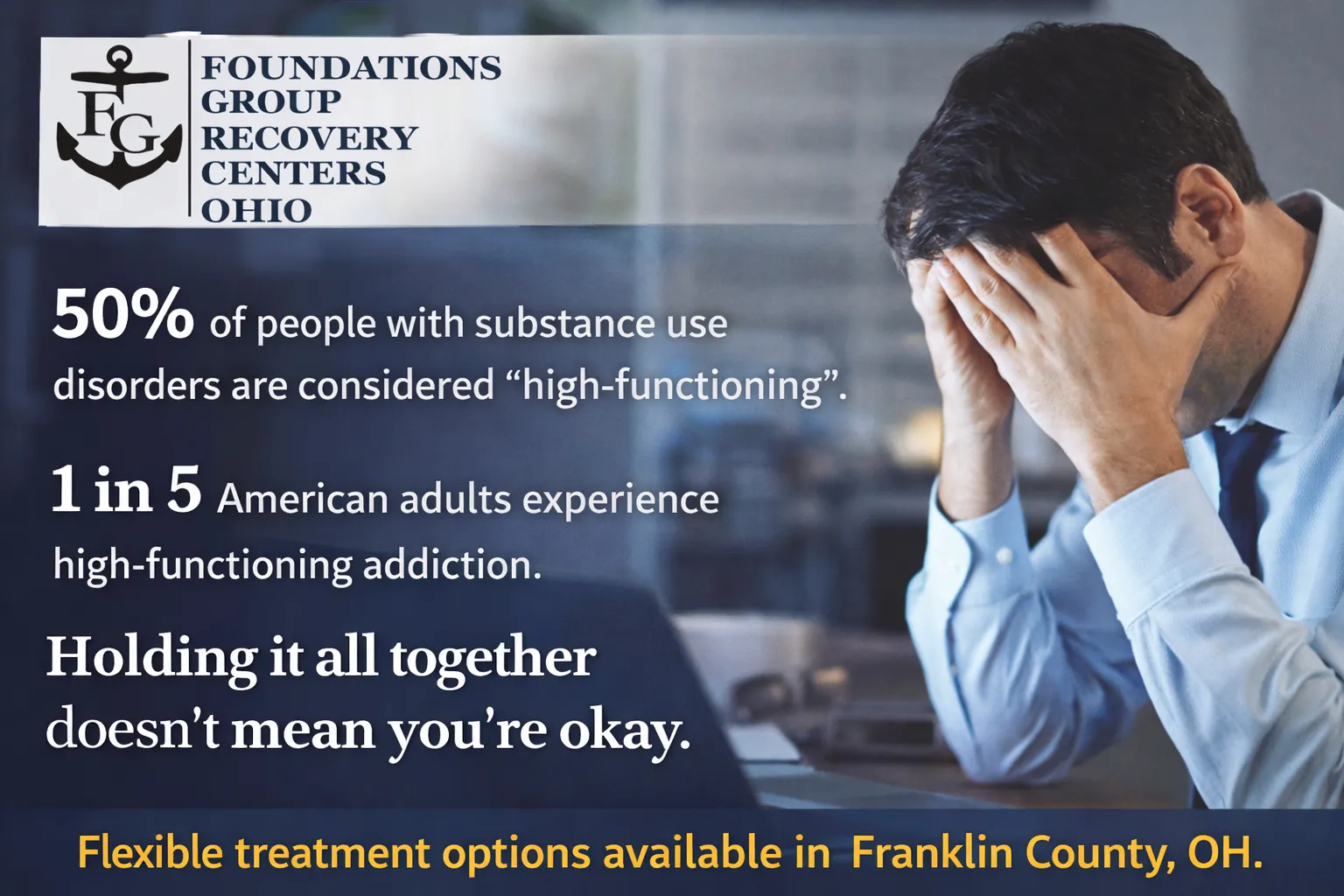
High-functioning doesn’t mean you’re fine.
It just means you’re good at hiding it.
And there’s always a cost:
- The burnout that doesn’t go away
- The anxiety that sits just under the surface
- The feeling that you’re never fully present
It’s like running your life in the background while something else quietly drains the battery.
Eventually, it catches up.
The question is whether you wait for that—or interrupt it.
A Local Reality That Made It Feel Possible
One of the reasons I didn’t take action sooner was because it all felt too disruptive.
I didn’t want to leave everything behind to get help.
But realizing there were options available close to home—especially in Franklin County, Ohio, with access to care in Upper Arlington, Ohio—made it feel realistic in a way it hadn’t before.
I didn’t have to disappear.
I just had to start.
If You’re Still Saying “It’s Not That Bad”
You might be right.
Maybe it’s not.
But here’s a better question:
Is this actually working for you?
Because I kept focusing on whether things were “bad enough” instead of asking whether they were sustainable.
And they weren’t.
You don’t have to wait for things to fall apart to make a change.
You can step in while everything still looks okay.
That’s not overreacting.
That’s paying attention.
What I’d Tell You If We Were Sitting Across From Each Other
I wouldn’t tell you to blow up your life.
I wouldn’t tell you everything has to change overnight.
I’d just say this:
If part of you is tired of holding it all together alone, you don’t have to keep doing that.
There’s a version of support that fits into your life—not one that replaces it.
And sometimes, that’s all it takes to shift things.
FAQ: The Questions I Had (But Didn’t Say Out Loud)
Do I really need help if I’m still functioning?
Functioning doesn’t mean thriving. If it’s costing you energy, peace, or clarity, it’s worth paying attention to.
What if I can handle it on my own?
Maybe you can. But the real question is—do you want to keep doing it alone if you don’t have to?
Will getting help mess up my work or routine?
Not necessarily. There are options designed to fit around your life, not interrupt it.
What if I’m overthinking this?
That thought alone usually means something is worth exploring. Most people don’t question it this deeply unless something feels off.
What if it’s not “bad enough” yet?
You don’t need to hit a breaking point to make a change. In fact, starting earlier often makes things easier, not harder.
A Way to Start Without Losing Everything
If you’ve been holding this together quietly, you don’t have to keep doing it alone.
Call (888)501-5618 to learn more about our intensive outpatient program in Upper Arlington, Ohio.
You don’t have to prove how much you can handle.
Sometimes the strongest move is admitting you don’t want to handle it like this anymore.