Cash flow issues in addiction treatment programs ohio rarely come from a single failure point. More often, they stem from small breakdowns across intake, documentation, billing, and utilization that compound over time.
For practice owners, a well-structured partial hospitalization program ohio can become the most stable and predictable revenue driver in the organization—but only if it’s operationally sound. Applying proven systems like those used in partial hospitalization program frameworks allows you to move from inconsistent collections to reliable cash flow.
This guide walks through exactly how to stabilize revenue step by step—without compromising care quality or overburdening your team.
Step 1: Diagnose Where Revenue Is Actually Breaking Down
Before implementing solutions, you need clarity on where cash flow is leaking.
Most practices assume billing is the issue—but data often shows otherwise.
Common breakdown points:
- Incomplete or inaccurate insurance verification
- Delayed or missing authorizations
- Documentation gaps affecting claim approval
- Underutilized program capacity
- Slow claim submission cycles
Action Framework:
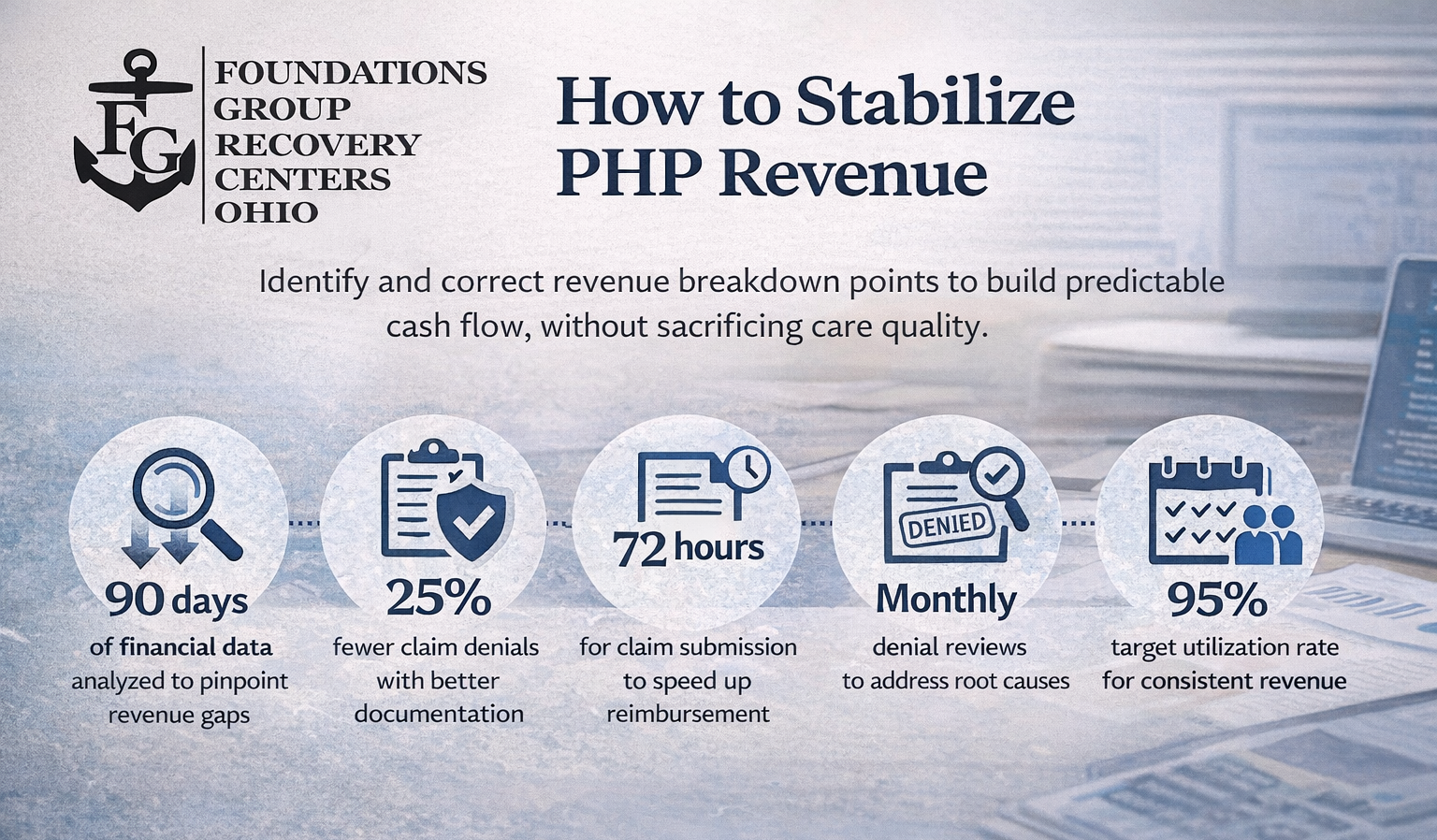
- Pull 90 days of financial data
- Identify denial rates by payer
- Measure average Days in Accounts Receivable (A/R)
- Track utilization rates for PHP
Benchmark Targets:
- Denial rate: under 10%
- A/R: under 40 days
- Program utilization: 85–95%
Without this baseline, revenue strategies become guesswork.
Step 2: Strengthen Intake to Prevent Downstream Loss
Revenue stability starts before a patient even enters your program.
Front-end errors create downstream financial issues that are difficult—and sometimes impossible—to recover.
Your intake process should include:
- Full benefits verification (not just eligibility)
- Confirmation of PHP coverage limits
- Pre-authorization secured prior to admission
- Documentation of medical necessity at intake
Example:
A missed authorization can result in a $5,000–$15,000 claim denial for a single patient episode.
Operational Fix:
- Implement a standardized intake checklist
- Assign ownership of verification to a dedicated role
- Use real-time tracking for authorization timelines
Step 3: Build Documentation That Protects Every Claim
Documentation is where revenue is either secured—or lost.
To support reimbursement, every clinical note must:
- Reflect individualized patient presentation
- Document specific interventions
- Show measurable response to treatment
- Reinforce medical necessity for PHP level of care
Avoid:
- Generic or templated language without variation
- Missing links between symptoms and treatment
- Delayed documentation
Data Insight:
Programs that implement structured documentation workflows reduce denials by up to 25%.
Implementation Checklist:
- Use standardized templates with required fields
- Conduct weekly documentation audits
- Provide ongoing clinician training based on audit findings
Step 4: Accelerate Your Billing Cycle
Even clean claims can create cash flow issues if they are delayed.
To improve revenue velocity:
- Submit claims within 24–72 hours of service delivery
- Use claim scrubbing tools to reduce errors
- Monitor claim status daily—not weekly
Key Metrics to Track:
- First-pass acceptance rate (target: 90%+)
- Days in A/R (target: <40 days)
- Average reimbursement turnaround time
Example:
Reducing claim submission delays by just 5 days can improve monthly cash flow by 10–15%.
Step 5: Actively Manage Denials Instead of Reacting to Them
Denials are not random—they follow patterns.
Instead of addressing them individually, build a system to identify root causes:
- Categorize denials (medical necessity, administrative, coverage)
- Track denial trends by payer
- Implement targeted corrections
Example:
If a specific payer consistently denies claims due to insufficient documentation, the issue lies in clinical training—not billing.
Operational Strategy:
- Conduct monthly denial reviews
- Share findings with both billing and clinical teams
- Implement corrective actions within 30 days
Step 6: Maximize PHP Utilization Without Overextending Resources
Revenue stability is directly tied to program utilization.
An underfilled PHP creates immediate revenue loss—even if everything else is optimized.
To improve utilization:
- Maintain consistent scheduling
- Track daily attendance
- Implement re-engagement protocols for missed sessions
Financial Impact:
Operating at 80% capacity instead of 95% can result in tens of thousands in lost monthly revenue.
Action Step:
- Monitor utilization weekly
- Adjust staffing and scheduling based on demand
- Align referral pipelines with program capacity
Step 7: Align Clinical, Operations, and Billing Teams
One of the most overlooked revenue issues is misalignment between departments.
Clinical teams focus on care. Billing teams focus on reimbursement. Without alignment, gaps form.
To stabilize operations:
- Hold monthly cross-functional meetings
- Share denial trends with clinicians
- Align documentation standards with billing requirements
Key Insight:
Organizations that integrate clinical and revenue cycle management processes outperform siloed models in both revenue and compliance outcomes.
Local Market Factors That Influence Revenue Stability
In competitive regions like Franklin County, Ohio, where patient demand intersects with high provider density in Columbus, Ohio, payer scrutiny tends to be higher.
This means:
- Documentation must be stronger to justify care
- Authorization processes must be airtight
- Program differentiation becomes critical
In these markets, revenue stability is not just about efficiency—it’s about credibility with payers.
Common Objections Practice Owners Have
“This feels like too many operational changes.”
Most of these changes are process improvements—not overhauls. Small adjustments compound into significant financial impact.
“Will this increase administrative burden?”
Initially, yes—but it reduces rework, denials, and delays, ultimately saving time and improving efficiency.
“Can PHP really stabilize revenue long-term?”
Yes—when properly structured, PHP is one of the most consistent revenue streams due to its intensity and reimbursement rates.
Frequently Asked Questions
How long does it take to stabilize revenue in a PHP?
Most programs see measurable improvements within 60–90 days after implementing structured workflows.
What is the fastest way to improve cash flow?
Improving intake verification and speeding up claim submission typically produces the quickest results.
How often should denial trends be reviewed?
Monthly reviews are recommended, with immediate action taken on recurring issues.
What role does staffing play in revenue stability?
Staffing directly impacts documentation quality, patient engagement, and program utilization—all of which affect revenue.
Can smaller practices implement these systems?
Yes. In fact, smaller practices often benefit more quickly because changes can be implemented faster.
Is outsourcing revenue cycle management necessary?
Not always—but expert guidance can accelerate implementation and reduce costly trial-and-error.
Build a Revenue System That Works Consistently
Stabilizing cash flow in addiction treatment programs ohio requires more than fixing billing issues. It requires aligning intake, documentation, utilization, and operations into a cohesive system.
A well-managed partial hospitalization program ohio can provide predictable, scalable revenue—if it’s built with discipline and monitored consistently.
Take the Next Step Toward Financial Stability
If your organization is experiencing inconsistent cash flow, now is the time to implement systems that protect and grow your revenue.
Call (888)501-5618 to learn more about our partial hospitalization program in ohio.
Stable revenue isn’t luck.
It’s structure.