I remember the relief more than anything.
Not the kind that comes from healing—but the kind that comes from stepping away.
No more early mornings.
No more check-ins.
No more sitting in rooms where I had to be honest, even when I didn’t feel like it.
I told myself I had graduated from needing help.
And for a little while, that story held up.
If you’re in that space right now—where you’ve had some time, some distance, maybe even some pride—you’re not wrong for wanting your life back. I wanted mine too.
But I didn’t realize I was also walking away from the very things that were quietly holding me together.
If you’re starting to feel that shift again, it might help to look at support differently this time—something like structured daytime care that doesn’t take your life away, but actually helps you live it.
I Didn’t Leave Because I Wanted to Use Again
That’s the part I wish more people understood.
I didn’t wake up one day and decide to throw everything away.
I left because I felt better.
Because I thought:
- I’ve learned what I needed to learn
- I’m not like I used to be
- I can handle this now
And honestly, those thoughts weren’t completely wrong.
I had changed.
But I misunderstood something important:
Feeling better isn’t the same as being steady.
There’s a difference between momentum and maintenance.
And I stepped out right when I needed maintenance the most.
The Silence That Replaced Structure
At first, it felt like freedom.
No one asking how I was doing.
No one noticing if I wasn’t okay.
No one holding me accountable.
But slowly, that silence started to feel different.
Heavier.
Because when things got hard—and they always do—there was nowhere for it to go.
No space to say:
- I’m struggling today
- I don’t feel like myself
- Something feels off
So I kept it to myself.
And what you keep to yourself has a way of growing.
The Thoughts That Came Back Before the Behavior Did
It didn’t start with action.
It started with permission.
Small, quiet thoughts like:
- Maybe I wasn’t that bad before
- Other people can drink normally—why can’t I?
- I’ve proven I can stop… so what’s the risk?
Those thoughts didn’t feel dangerous. They felt logical.
That’s what made them so convincing.
I wasn’t trying to relapse. I was trying to redefine the rules.
But the rules didn’t change—only my awareness of them did.
The Part No One Sees: The In-Between
There’s a space people don’t talk about enough.
You’re not in full control—but you’re not completely out of control either.
You’re functioning. Showing up. Getting through your day.
But underneath it, something feels off.
Disconnected. Tense. A little bit like you’re pretending.
That was me.
And the hardest part?
I kept telling myself I could fix it quietly.
Without help. Without telling anyone. Without going “back.”
How It Actually Slipped
There wasn’t a dramatic moment.
No big fall. No breaking point.
Just a series of small decisions:
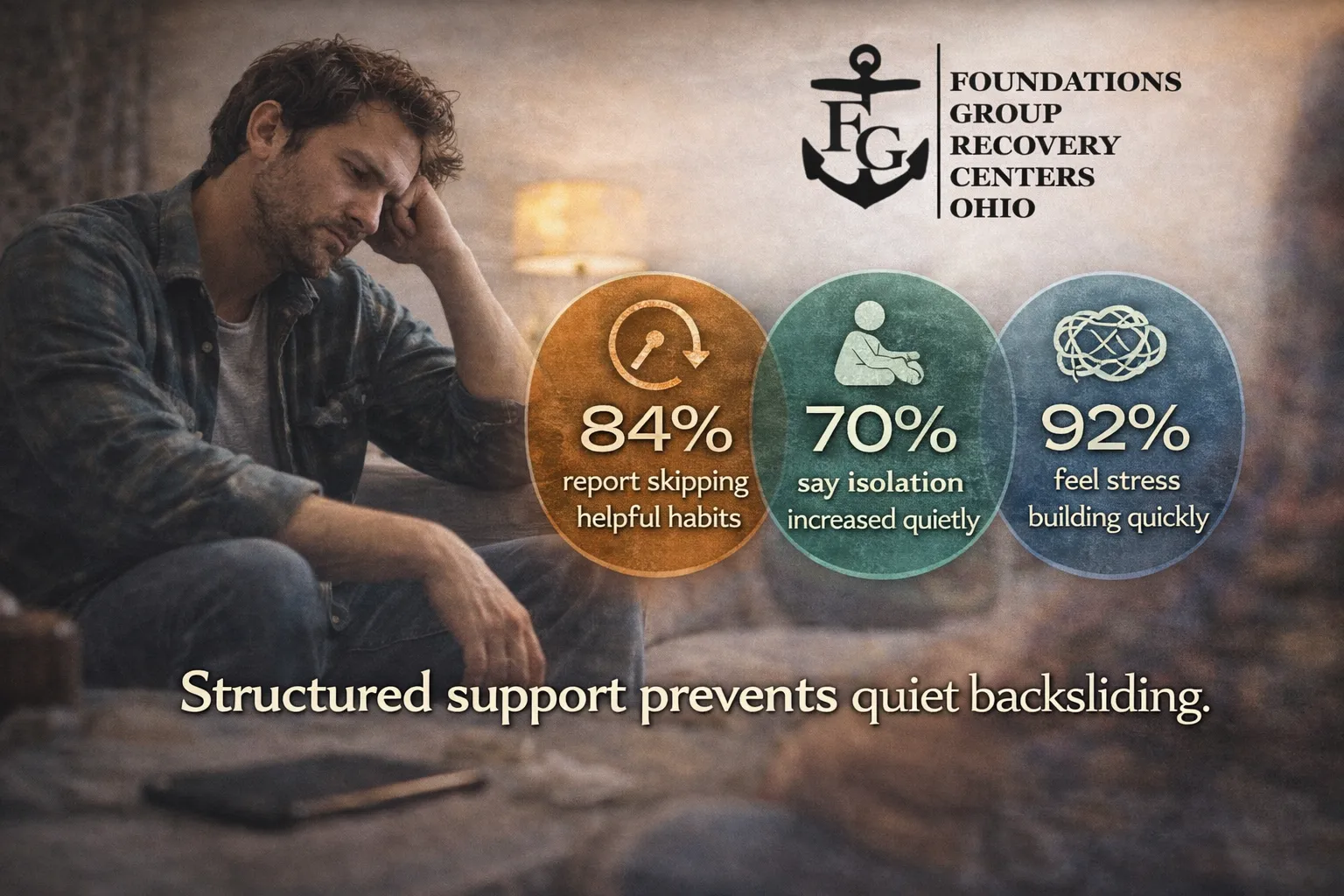
- Skipping things that used to help
- Isolating more than I realized
- Letting stress pile up without releasing it
Then one day, I crossed a line I had promised I wouldn’t.
And even then, I minimized it.
It’s just this once.
It doesn’t mean anything.
But deep down, I knew.
Because something had shifted again—and I could feel it.
The Moment I Had to Get Honest
It didn’t happen in front of anyone else.
No confrontation. No intervention.
Just a quiet moment where I couldn’t ignore it anymore:
I don’t feel like I’m in control of this.
That’s a hard sentence to admit—especially after you’ve already “proven” you could stop.
There’s shame in that.
There’s ego in that.
There’s a voice that says:
You should’ve known better.
But there’s also something else, if you listen closely:
You’re still paying attention.
And that matters.
Why Going Back Felt Harder Than Starting
Walking into support the first time felt scary.
Walking back felt… heavier.
Because this time, I had a story attached:
- I already did this
- People are going to think I failed
- I should’ve been able to handle it
But none of that actually showed up the way I expected.
What I found instead was something different:
Space.
No judgment. No lectures. No “you should’ve known better.”
Just people who understood that this happens—and that coming back takes more courage than staying stuck.
What Changed the Second Time Around
The biggest shift wasn’t the program.
It was me.
I wasn’t trying to prove anything anymore.
I wasn’t trying to rush through it.
I wasn’t trying to convince myself I was “fixed.”
I was just trying to be honest.
And that made the support land differently.
This time, I didn’t need to disappear from my life to get help.
Something like day treatment columbus ohio made sense in a way it didn’t before—not as something intense or overwhelming, but as something structured enough to keep me steady.
It gave me:
- Support during the hours I used to struggle the most
- A place to process things before they built up
- A rhythm that helped me feel grounded again
It didn’t feel like starting over.
It felt like catching myself before things went further.
Why Structure Isn’t the Enemy
I used to think structure meant restriction.
Now I see it differently.
Structure is what gives you space to breathe without falling apart.
It’s not about controlling your life—it’s about supporting it.
Without it, everything starts to rely on willpower.
And willpower is the first thing to go when life gets hard.
A Local Reality That Made It Easier to Say Yes
For me, part of the resistance was practical.
I didn’t want to uproot my life again. I didn’t want something that felt all-consuming.
Knowing there were options close to home in Columbus, Ohio, and even more specifically in Upper Arlington, Ohio, made it easier to consider support without feeling like I was disappearing from my own life.
That mattered more than I expected.
Sometimes the barrier isn’t willingness—it’s how realistic the support feels.
If You’re Telling Yourself You Don’t Need Help
I get it.
That voice sounds confident. Independent. Strong.
But sometimes it’s also tired.
Tired of trying. Tired of being watched. Tired of doing the work.
And instead of saying that, it says:
I’m fine.
So let me ask you something gently:
Are you actually fine…
or are you just trying to handle it quietly?
Because those are not the same thing.
You Didn’t Lose Everything You Built
This part matters.
Relapse—or even slipping back mentally—has a way of making everything feel erased.
Like those 90 days didn’t count.
Like the progress disappeared.
It didn’t.
You still have:
- Awareness you didn’t have before
- Experience you can build on
- A version of yourself that knows what stability feels like
That doesn’t go away.
It just gets buried under everything you’re trying to carry alone.
FAQ: If You’re Sitting in This Right Now
Does needing help again mean I failed?
No. It means you reached a point where support matters again. That’s not failure—it’s awareness. Most people who stay sober long-term have moments like this.
How do I know if I need more support or just need to “get back on track”?
If you’re asking the question, it’s worth exploring. Trying to “fix it alone” usually keeps the cycle going longer than it needs to.
What if I don’t want something as intense as before?
That’s valid. Not all support looks the same. Options like structured daytime care exist specifically for people who need consistency without stepping away from daily life.
What if I’m embarrassed to come back?
Most people are. But the reality is—people respect you more for coming back than pretending you don’t need help.
Can things actually feel better again?
Yes. Not instantly. Not perfectly. But steadily—yes. Especially when you stop trying to carry it alone.
A Way Forward That Meets You Where You Are
If something in this feels familiar, you don’t have to wait for it to get worse before doing something about it.
Call (888)501-5618 to learn more about our partial hospitalization program in Upper Arlington, OH.
You didn’t come this far just to pretend you don’t need support anymore.
And the part of you that’s reading this?
That part isn’t gone.
It’s still paying attention.
And that might be the most important thing you have right now.