There is a moment that happens for a lot of sober curious people.
Usually, it isn’t dramatic.
You’re not getting arrested. You’re not losing your job. You’re not waking up in a hospital bed.
You’re sitting on your couch after work wondering why something that once felt relaxing now feels exhausting.
Maybe you’ve started setting rules for yourself.
No drinking during the week.
Only on weekends.
Only two drinks.
Only after dinner.
Then somehow the rules keep changing.
You break them. You reset them. You promise yourself next week will be different.
For a while, that cycle can feel manageable.
Until it doesn’t.
At Foundations Group Recovery Center Ohio, we’ve spoken with many people who delayed reaching out because they believed getting help meant putting their careers on hold. They imagined treatment as something reserved for people whose lives had completely fallen apart.
The reality is often very different.
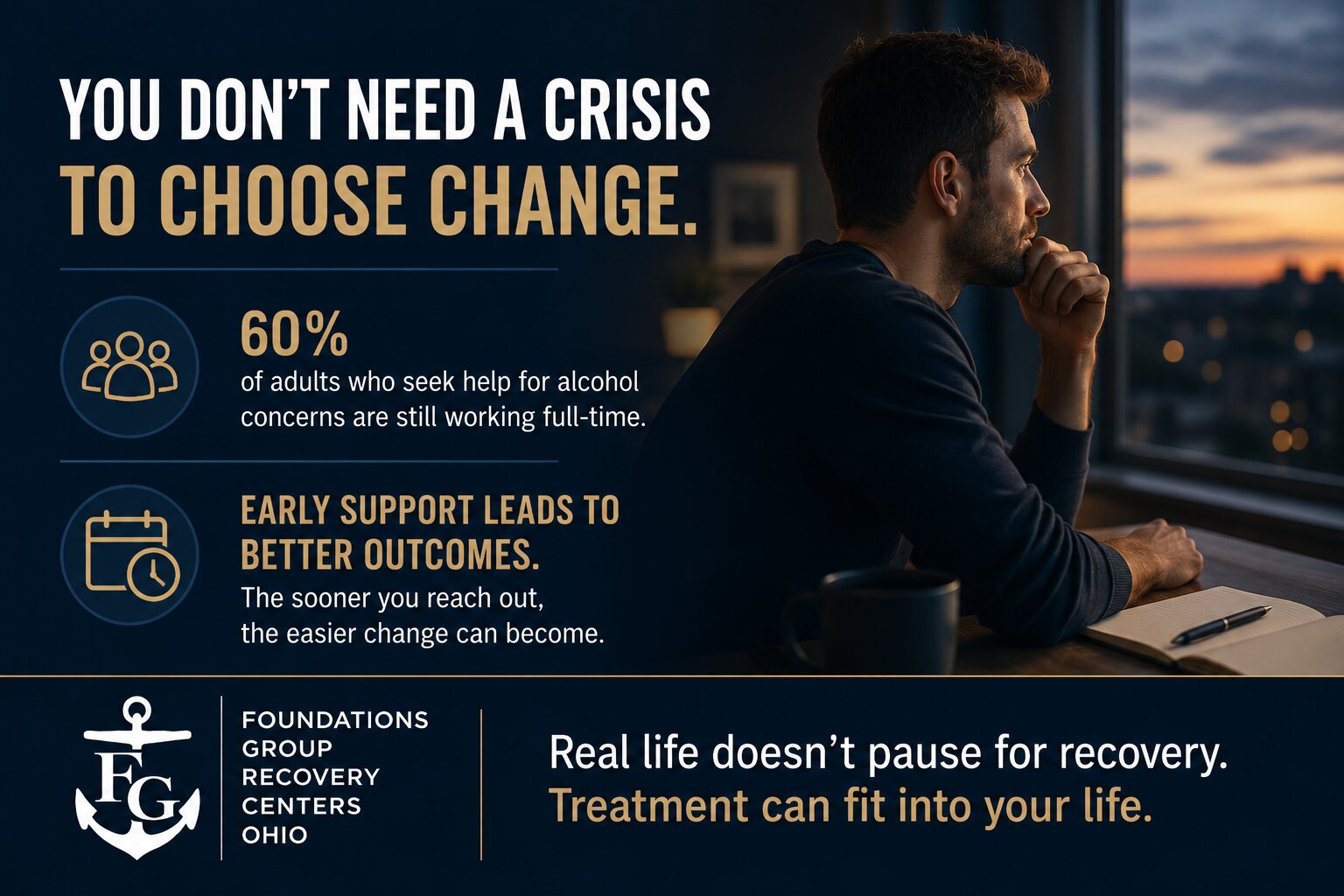
Many people who seek help are still working, still paying bills, still raising families, and still showing up every day. They’re simply tired of carrying the same concerns into every week.
If you’re searching for answers while trying to keep your job, it may help to learn more about alcohol recovery support options and how treatment can fit into real life rather than replace it.
Step 1: Stop Waiting for a Crisis to Give Yourself Permission
One of the most common things we hear is:
“I don’t think I’m bad enough yet.”
That sentence keeps people stuck for months.
Sometimes years.
Many people imagine addiction support is only for those experiencing severe consequences.
But recovery isn’t reserved for people at rock bottom.
It’s available to anyone who recognizes that alcohol is taking more than it’s giving.
Maybe your drinking isn’t costing you your job.
Maybe it’s costing you your energy.
Your sleep.
Your confidence.
Your patience.
Your peace of mind.
Those losses matter too.
You don’t need a disaster to justify seeking help.
Sometimes discomfort is enough.
Step 2: Take an Honest Inventory of Your Daily Life
When people evaluate their drinking, they often ask the wrong question.
They ask:
“Can I still function?”
A more useful question is:
“How much effort is functioning taking?”
There’s a difference.
Many high-functioning drinkers are running an emotional marathon every day.
They’re exhausted.
They’re anxious.
They’re relying on alcohol to unwind while simultaneously worrying about their relationship with alcohol.
That internal conflict can become incredibly draining.
Consider these questions:
- Do you think about drinking more than you’d like?
- Do you spend time planning around alcohol?
- Have you tried cutting back repeatedly without success?
- Are you drinking more than you intended?
- Has alcohol become your primary way of coping with stress?
You don’t need every answer to be yes.
The goal is awareness.
Awareness often becomes the first step toward change.
Step 3: Understand That Help Doesn’t Always Mean Leaving Everything Behind
This is where many people experience relief.
The assumption that treatment automatically requires stepping away from work keeps countless individuals from reaching out.
In reality, treatment exists on a spectrum.
Some people need round-the-clock support.
Others benefit from structured daytime care.
Many working adults seek options that allow them to maintain employment while receiving meaningful recovery support.
Evening treatment schedules can make this possible.
For someone balancing professional responsibilities, that flexibility can remove one of the biggest barriers to seeking help.
The question becomes less about choosing between work and recovery.
Instead, it becomes about learning how recovery can support your work, your health, and your future.
Step 4: Recognize the Pattern Behind Your Search
People rarely search for help after one difficult night.
Usually, there’s a pattern.
You’ve thought about your drinking before.
You’ve worried about it before.
You’ve promised yourself you’d make changes before.
The search itself often represents something important.
It means a part of you recognizes that continuing exactly as you are may not be working.
That’s worth paying attention to.
Think about why you’re reading this right now.
Something motivated you.
Maybe you woke up feeling disappointed.
Maybe someone expressed concern.
Maybe you’re tired of relying on alcohol to manage stress.
Maybe you’re simply curious whether life could feel better.
Whatever brought you here deserves respect.
Curiosity can be the beginning of transformation.
Step 5: Stop Treating Willpower Like a Treatment Plan
Many sober curious individuals believe the solution is simply trying harder.
More discipline.
More determination.
More self-control.
The problem is that alcohol use challenges are rarely solved through willpower alone.
If willpower were enough, most people would have already changed.
Support matters because it provides tools, accountability, structure, perspective, and guidance.
Imagine trying to learn a new language without teachers, books, classes, or practice partners.
Could you eventually figure it out?
Maybe.
Would it be harder?
Almost certainly.
Recovery works similarly.
Support shortens the distance between where you are and where you want to be.
Step 6: Think About What You Want to Gain
When people consider treatment, they often focus on loss.
What will I have to give up?
What will change?
What won’t I be able to do anymore?
But recovery isn’t only about subtraction.
It’s also about addition.
Better sleep.
Clearer mornings.
More confidence.
Improved concentration.
Healthier relationships.
Reduced anxiety.
Greater freedom.
One client described recovery this way:
“I thought I was giving something up. It turned out I was getting my life back.”
That perspective shift can be powerful.
Step 7: Understand That Privacy and Professional Life Can Coexist
Many working professionals worry about stigma.
They worry coworkers will find out.
They worry employers will judge them.
They worry seeking help will somehow define them.
The truth is that many people pursuing recovery continue working successfully throughout the process.
Teachers.
Nurses.
Executives.
Sales professionals.
Business owners.
Tradespeople.
Parents.
Alcohol challenges do not discriminate.
Neither does recovery.
Seeking support is not a sign of weakness.
It’s often one of the most responsible decisions a person can make.
Why Waiting Usually Feels Safer Than It Really Is
Waiting feels comfortable because it doesn’t require change.
You tell yourself you’ll reassess next month.
After the holidays.
After the busy season.
After the next project.
After the next stressful week.
The problem is that alcohol-related concerns often grow quietly.
What feels manageable today may become harder tomorrow.
Meanwhile, the opportunity cost continues to accumulate.
More stress.
More fatigue.
More frustration.
More time spent wondering.
One of the biggest regrets people share is not reaching out sooner.
Not because recovery was easy.
Because they realized they had been carrying the burden alone for far longer than necessary.
Why So Many Working Adults Explore Evening Treatment
At Foundations Group Recovery Center Ohio, we’ve met people from every professional background imaginable.
What they often share is a desire to receive support without abandoning their responsibilities.
They want help that fits real life.
They want accountability.
They want structure.
They want guidance.
But they also want to continue showing up for work, family, and personal obligations.
That’s why many individuals researching outpatient alcohol rehab Columbus options are looking specifically for schedules that align with working life.
They aren’t trying to avoid recovery.
They’re trying to make recovery possible.
And for many people, that’s exactly where meaningful change begins.
You Don’t Need to Decide Everything Today
One reason people get overwhelmed is because they think they need every answer immediately.
Do I need treatment?
Will it work?
How long will it take?
What happens next?
Those are important questions.
But they don’t all need answers today.
The only thing you need to decide today is whether you’re willing to learn more.
Whether you’re willing to explore possibilities.
Whether you’re willing to believe that life could feel different than it does right now.
Sometimes recovery starts with a phone call.
Sometimes it starts with a conversation.
Sometimes it starts with reading a blog and realizing you’re not the only person asking these questions.
Hope rarely arrives all at once.
More often, it arrives one small step at a time.
Frequently Asked Questions
Can I get help for drinking without quitting my job?
Many people continue working while participating in treatment. Depending on your needs, there may be options designed to fit around professional and personal responsibilities.
Do I have to identify as an alcoholic to seek help?
No. Many people seek support because they are concerned about their relationship with alcohol or want to make changes before problems become more severe.
What if I’m not sure my drinking is serious enough?
If you’re questioning your alcohol use, that concern is worth exploring. You do not need to wait for major consequences before seeking guidance.
Can treatment help if I’ve never been in rehab before?
Yes. Many people entering treatment are doing so for the first time. Seeking help early can often prevent alcohol-related concerns from becoming more disruptive.
Is evening treatment only for people with mild alcohol problems?
Not necessarily. The appropriate level of care depends on many factors, including drinking patterns, support systems, mental health concerns, and overall recovery needs.
Why do people search for outpatient alcohol rehab Columbus while still working?
Many individuals want meaningful support without stepping away from their careers. Flexible treatment schedules can allow people to pursue recovery while maintaining professional responsibilities.
What is the first step if I’m sober curious?
The first step is often gathering information and having an honest conversation about your concerns. You don’t need to commit to treatment immediately to start exploring your options.
Call (888)501-5618 or visit our substance use treatment Ohio page to learn more about our substance use treatment Upper Arlington, Ohio, alcohol addiction treatment services in Franklin County, Ohio.