I spent almost six months researching treatment without actually making a decision.
At least that’s what I told myself.
Every evening after work, I would sit on my couch, laptop open, typing slightly different versions of the same question into Google.
Should I step away from work?
Can I recover while keeping my career?
What if I choose the wrong program?
How long will treatment take?
What if none of it works?
The questions changed.
The fear stayed the same.
Looking back, I realize I wasn’t gathering information.
I was looking for certainty.
And certainty never came.
If you’re a working professional trying to decide what kind of support makes sense for opioid addiction, I understand that feeling. Years later, as someone with long-term recovery, I can tell you that the decision felt much bigger than it actually was.
What changed my life wasn’t finding the perfect answer.
It was finally stopping long enough to ask for help.
If you’re exploring opioid recovery support while balancing work, family, and responsibilities, I hope my experience helps you feel a little less alone.
I Didn’t Think I Looked Like Someone Who Needed Treatment
I had a good job.
People respected me.
My bills were paid.
My performance reviews were strong.
Nobody would have described me as someone struggling with addiction.
Including me.
That was part of the problem.
I compared myself to stereotypes.
I believed treatment was for people whose lives had completely collapsed.
As long as I kept showing up to work, I convinced myself things weren’t that bad.
What nobody saw was the amount of energy required to maintain that appearance.
The mental calculations.
The constant planning.
The anxiety.
The secrecy.
The exhaustion.
Every day felt like carrying a backpack full of bricks while pretending it weighed nothing.
Eventually, that becomes impossible to sustain.
The Search Was Never Really About Treatment
When I look back now, I realize something important.
I wasn’t actually comparing treatment options.
I was trying to find a way to avoid making a choice.
I wanted someone to guarantee success.
I wanted certainty.
I wanted proof.
I wanted to know exactly what would happen before I took a single step.
Recovery doesn’t work that way.
Neither does life.
At some point, every meaningful decision involves uncertainty.
Treatment was no different.
The more I searched, the more I realized I wasn’t afraid of recovery.
I was afraid of change.
Work Had Become Part of My Identity
This is something many professionals understand immediately.
My career wasn’t just something I did.
It was part of who I was.
I was dependable.
Reliable.
Productive.
The person people called when they needed something done.
That identity felt important.
So when treatment entered the conversation, I interpreted it as a threat.
I worried I would lose momentum.
Lose opportunities.
Lose respect.
Lose control.
What I didn’t realize was that addiction was already taking those things away.
Just more slowly.
It’s easy to notice what treatment asks of you.
It’s harder to notice what addiction is quietly costing you every day.
I Thought Recovery Meant Pressing Pause on Life
One misconception kept me stuck longer than almost anything else.
I believed recovery required abandoning everything.
My career.
My responsibilities.
My routine.
My goals.
My future plans.
The reality was far more nuanced.
Different people need different levels of support.
Different schedules.
Different approaches.
Different structures.
The goal isn’t forcing everyone into the same experience.
The goal is helping people engage in recovery in a meaningful and sustainable way.
That realization changed everything.
Instead of asking whether recovery fit my life, I started asking how recovery could become part of my life.
That shift made the process feel possible.
The Most Honest Conversation I Ever Had
One night, a friend asked me a question I couldn’t avoid.
“If nothing changes, where will you be a year from now?”
I hated the question.
Because I already knew the answer.
Exactly where I was.
Still worried.
Still dependent.
Still exhausted.
Still researching.
Still hoping things would somehow improve without requiring me to change anything.
That realization hit hard.
Not because it was dramatic.
Because it was true.
I had spent months evaluating the risks of treatment.
I had spent almost no time evaluating the risks of staying the same.
That imbalance kept me stuck.
Recovery Didn’t Happen the Way I Expected
I expected some dramatic breakthrough.
A life-changing moment.
A single realization that would fix everything.
Instead, recovery happened quietly.
A better morning.
A difficult conversation handled differently.
A week with less anxiety.
An evening spent present instead of distracted.
A growing sense of trust in myself.
The changes felt small at first.
Almost invisible.
But small changes accumulate.
The way snowflakes eventually become a snowstorm.
The way individual drops eventually fill a bucket.
Recovery wasn’t built from one giant moment.
It was built from hundreds of ordinary ones.
Why Connection Mattered More Than Willpower
For years, I treated recovery like a personal challenge.
Something I should be able to solve alone.
That mindset nearly kept me trapped forever.
Eventually, I learned something humbling.
Willpower has limits.
Connection doesn’t.
The people who helped me most weren’t the people who had perfect answers.
They were the people who understood.
The people who listened.
The people who reminded me I wasn’t uniquely broken.
That mattered.
Because addiction thrives in isolation.
Recovery tends to grow in connection.
What Treatment Didn’t Take Away
I was convinced recovery would cost me something.
My ambition.
My drive.
My career.
My identity.
My future.
Instead, recovery gave me things back.
Energy.
Clarity.
Focus.
Peace of mind.
Time.
Presence.
The ability to enjoy success without secretly worrying about what would happen if everything fell apart.
I didn’t lose my identity.
I stopped building my identity around surviving.
That’s a very different thing.
Why Long-Term Alumni Sometimes Feel Stuck
This may sound strange, but even after years in recovery, people can feel disconnected.
Not because they’re using again.
Because life gets busy.
Work becomes demanding.
Relationships change.
Stress returns.
The routines that once supported recovery slowly drift into the background.
I’ve seen long-term alumni experience this countless times.
They aren’t in crisis.
They’re disconnected.
And disconnection can feel surprisingly lonely.
That’s one reason stories matter.
Hearing someone else’s experience reminds us we’re not alone.
Reminds us that recovery isn’t a finish line.
It’s a relationship we continue building.
Looking Beyond “Which One Is Better?”
When people compare different treatment options, they’re often asking the wrong question.
I know because I asked it too.
I kept asking:
“Which option is better?”
The better question turned out to be:
“Which option gives me the greatest chance of fully engaging in recovery?”
That’s different.
Because recovery isn’t a competition.
It’s not about choosing the most impressive path.
It’s about choosing the path you will actually commit to.
The path you’ll show up for.
The path that helps you move forward.
That’s what matters.
The Thing I Wish Someone Had Told Me Earlier
I wish someone had told me that uncertainty is normal.
Fear is normal.
Skepticism is normal.
Questions are normal.
Most people don’t enter recovery feeling completely confident.
They enter recovery because they finally become more tired of staying stuck than they are afraid of moving forward.
That was true for me.
It may be true for you too.
At Foundations Group Recovery Center Ohio, people exploring recovery can find support in Areas We Serve or seek additional care in Upper Arlington while learning about options that fit their lives and responsibilities.
The goal isn’t choosing a perfect path.
The goal is taking the next honest step.
Sometimes that’s enough to change everything.
Frequently Asked Questions
Can working professionals successfully recover from opioid addiction?
Yes. Many people in recovery continue working, raising families, and managing significant responsibilities while receiving treatment and ongoing support.
How do I know whether I need more intensive treatment or a flexible option?
The best choice depends on your substance use history, support system, daily responsibilities, health needs, and recovery goals. Professional assessments can help guide that decision.
Do I have to stop working to get help?
Not always. Many individuals seek treatment options that allow them to remain engaged in work and family responsibilities while receiving support.
Why do professionals wait so long before seeking treatment?
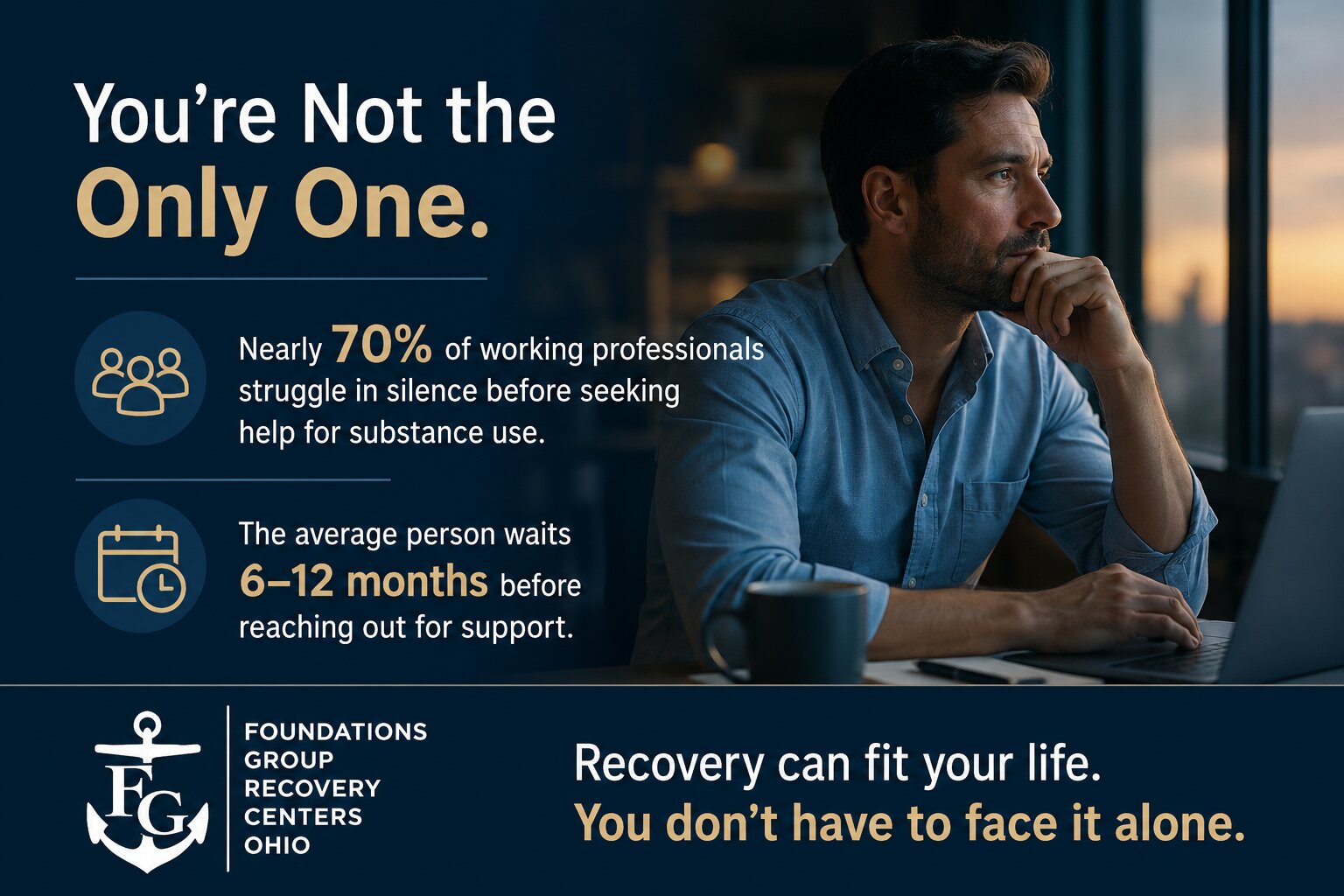
Many people fear disrupting their careers, losing opportunities, or being judged. Others convince themselves they’re functioning well enough to avoid addressing the problem.
Is outpatient opioid treatment Columbus residents search for always the right choice?
Not necessarily. Different people need different levels of care. What matters most is finding the level of support that helps you fully engage in recovery.
What happens after treatment ends?
Recovery continues after formal treatment. Ongoing connection, support, healthy routines, and accountability often play important roles in long-term success.
What is the first step if I’m unsure what kind of treatment I need?
The first step is often a conversation. Learning about available options and discussing your circumstances with professionals can help clarify what support may be most appropriate.
Call (888)501-5618 or visit our substance use treatment Ohio page to learn more about our substance use treatment Ohio, opiate addiction treatment Columbus, Ohio.