
Your child says they’re fine.
Maybe they still go to work. Maybe they’re still paying some bills, showing up to family dinners occasionally, or answering your texts just enough to keep concern at arm’s length.
From the outside, nothing looks catastrophic.
And that’s exactly what makes this so confusing for parents.
Because deep down, something still feels wrong.
You notice the exhaustion in their face. The irritability. The emotional distance. The way alcohol quietly became part of almost every evening—or every day. You tell yourself not to overreact, but your instincts keep circling back to the same question:
“What if this is becoming something more serious?”
Many parents searching for structured daytime addiction support in Ohio are not trying to shame their child or force them into treatment overnight. They’re trying to understand the line between “normal young adult behavior” and a growing problem that’s starting to change someone they love.
That uncertainty can feel incredibly lonely.
Daily Drinking Often Hides Inside “Normal” Life
One reason families miss early warning signs is because problematic drinking rarely begins in dramatic ways.
It usually looks ordinary at first.
A few drinks after work. Drinking to unwind socially. Alcohol helping them sleep. Weekend drinking slowly stretching into weekdays. A rough breakup. Stress at school. Anxiety they don’t know how to talk about.
Young adulthood is already emotionally messy. That’s what makes this so difficult to recognize.
Parents often explain away warning signs because they remember being young themselves. They don’t want to panic unnecessarily. They don’t want to damage trust by accusing their child of having a problem too early.
So they rationalize:
- “Everyone drinks at that age.”
- “At least they’re still functioning.”
- “They’re under a lot of pressure.”
- “It’s probably temporary.”
And sometimes it is temporary.
But sometimes alcohol slowly becomes emotional survival instead of recreation.
That shift matters.
“They’re Still Working” Can Create False Reassurance
Many families expect addiction to look chaotic and obvious.
But some of the most struggling people we meet are still going to work every day.
They’re still:
- Paying rent
- Showing up to class
- Maintaining relationships
- Smiling socially
- Posting normal-looking photos online
That external functioning can make parents doubt themselves.
But functioning does not always mean emotionally healthy.
A young adult may still be highly distressed internally while appearing “fine” publicly. In fact, many people become skilled at protecting that image because they’re afraid of what happens if someone sees how overwhelmed they really feel.
We often hear things like:
“I can stop anytime I want.”
Or:
“I’m just stressed.”
Or:
“It’s not affecting my life.”
Meanwhile, alcohol may already be shaping their sleep, mood, anxiety levels, emotional regulation, and sense of identity more than they realize.
And many people quietly searching phrases like rehab while working are trying to answer a question they’re too scared to say out loud:
“What if I need help before my whole life falls apart?”
Parents Usually Feel the Shift Before They Can Explain It
One of the hardest parts of parenting a struggling young adult is that intuition often arrives before clarity.
You may not have one dramatic moment that proves something is wrong.
Instead, you notice small emotional shifts accumulating over time.
Maybe they:
- Get irritated quickly
- Withdraw emotionally
- Avoid eye contact during serious conversations
- Seem exhausted all the time
- Drink alone more often
- Become defensive when alcohol is mentioned
- Lose interest in things they used to enjoy
- Feel anxious or restless without alcohol
Individually, these signs may seem explainable.
Together, they can signal a deeper emotional struggle forming underneath the surface.
Parents often describe this stage as:
“Feeling like I’m walking around with constant low-grade fear.”
That feeling deserves compassion too.
Alcohol Can Quiet Pain Young Adults Don’t Know How to Name Yet
Many young adults are not drinking simply because they want to “party.”
Sometimes alcohol becomes:
- Relief from anxiety
- Escape from depression
- A way to numb loneliness
- Protection against insecurity
- A shortcut to confidence
- A way to turn their brain off temporarily
And because alcohol often works temporarily, it becomes easy to rely on.
The problem is that emotional dependence tends to grow quietly.
Over time, the brain begins associating alcohol with safety, comfort, or emotional regulation. Without realizing it, someone may stop learning how to manage stress, boredom, sadness, or discomfort without drinking.
That’s why many young adults eventually reach a frightening realization:
“I don’t really know how to relax without alcohol anymore.”
That realization can trigger shame quickly.
And shame tends to keep people silent longer.
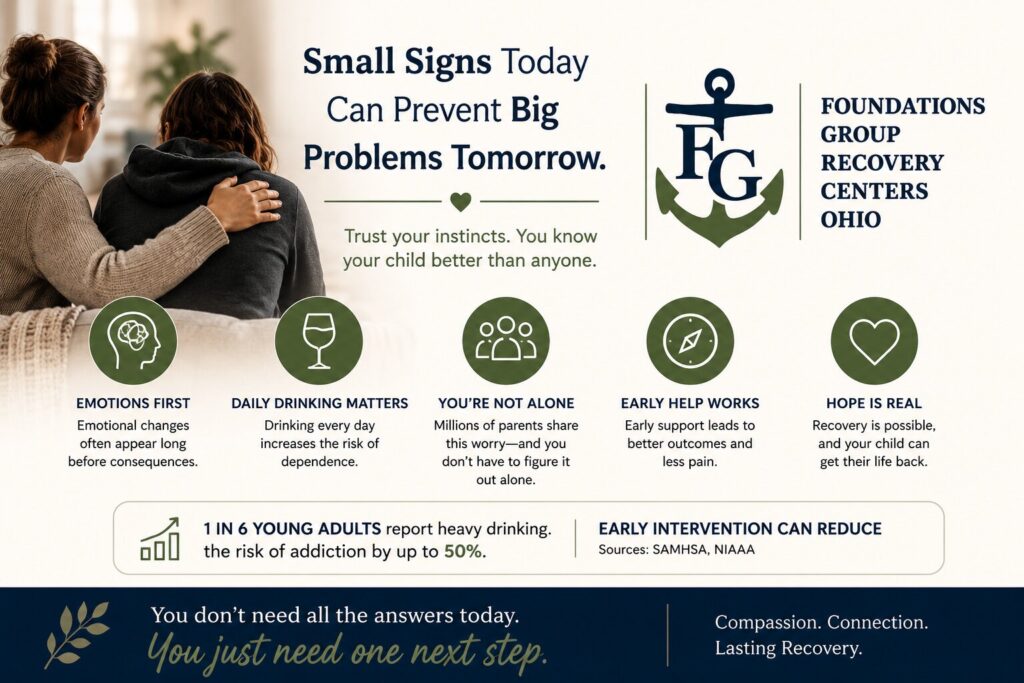
Families Sometimes Adapt Around the Problem Without Meaning To
This happens more often than parents realize.
The family starts quietly adjusting itself around the drinking:
- Avoiding hard conversations
- Pretending things are okay to keep peace
- Lowering expectations
- Ignoring behaviors they would have questioned before
- Walking carefully around conflict
Eventually, “they’re fine” becomes less of a belief and more of a coping strategy.
Because acknowledging the possibility of a serious problem feels terrifying.
Parents may secretly wonder:
- “Did I miss the signs?”
- “Am I enabling this?”
- “What if pushing too hard makes things worse?”
- “What if I don’t push hard enough?”
Those thoughts are incredibly common.
And they usually come from love—not failure.
Shame and Defensiveness Often Protect the Same Fear
One of the hardest parts for parents is understanding that defensiveness does not always mean denial.
Sometimes it means fear.
Young adults often understand more about their drinking than they admit openly. They may already feel embarrassed, trapped, or frightened by how dependent they’ve become emotionally.
But admitting that out loud can feel unbearable.
So instead, they:
- Minimize
- Deflect
- Joke about it
- Compare themselves to people “worse” than them
- Become angry when confronted
That reaction can be painful for families.
But underneath the defensiveness, many young adults are carrying enormous fear about what life would look like without alcohol.
Treatment Does Not Always Mean “Disappearing” From Life
This is important because many families picture treatment as something extreme.
They imagine their child having to completely disappear from work, school, relationships, or daily life indefinitely.
But support exists on a spectrum.
Some people benefit from live-in treatment and round-the-clock support. Others do well in structured daytime care that allows them to receive treatment while continuing parts of their routine and responsibilities.
That flexibility matters.
Many young adults delay seeking help because they fear losing independence, employment, or normalcy. Families searching for options related to rehab while working are often looking for something realistic—support that helps stabilize life rather than completely pause it.
And sometimes, simply learning there are multiple treatment paths lowers the emotional barrier enough for someone to finally say:
“Okay… maybe I need help.”
Hope Often Begins Smaller Than Families Expect
Recovery rarely starts with one dramatic breakthrough speech.
More often, it begins quietly.
A difficult conversation. A moment of honesty. A parent choosing calm instead of panic. A young adult admitting they’re exhausted. One appointment. One phone call. One small willingness to stop pretending everything feels manageable.
We’ve watched families arrive terrified that things were already beyond repair.
And we’ve also watched young adults slowly reconnect with themselves after getting support:
- Sleeping better
- Feeling emotionally clearer
- Rebuilding trust
- Managing anxiety differently
- Learning how to exist without needing alcohol every day
Not perfectly.
But genuinely.
Sometimes parents expect recovery to look like instant transformation. In reality, it often looks more like someone gradually becoming emotionally reachable again.
That process matters deeply.
You Do Not Need to Wait for Rock Bottom
This may be the most important thing a parent reading this needs to hear.
You do not need:
- A DUI
- Hospitalization
- Job loss
- Academic collapse
- Legal trouble
- Public humiliation
before seeking guidance.
If daily drinking is changing your child emotionally, physically, or relationally, that deserves attention now.
Early support can interrupt patterns before they become more dangerous or deeply rooted.
And sometimes the most loving thing a parent can do is stop focusing on whether their child technically “qualifies” as an addict and instead ask:
“Does my child genuinely seem emotionally okay?”
Because those are very different questions.
FAQ: Parents Concerned About Daily Drinking in Young Adults
Is daily drinking always alcoholism?
Not necessarily, but daily drinking can become concerning when alcohol is consistently used to manage emotions, anxiety, stress, sleep, or discomfort. Frequency and emotional dependence both matter.
What are the early warning signs parents often miss?
Parents commonly notice mood swings, defensiveness, emotional withdrawal, increased secrecy, exhaustion, anxiety without alcohol, and drinking becoming part of daily routine rather than occasional social use.
What if my child still has a job or goes to school?
Many people struggling with alcohol still appear functional externally. Working or attending school does not automatically mean someone is emotionally or physically healthy.
Why does my child become angry when I bring up drinking?
Defensiveness often comes from fear, shame, or discomfort—not simply rebellion. Many young adults already know something feels wrong but are scared to fully confront it.
Can anxiety or depression contribute to daily drinking?
Absolutely. Young adults frequently use alcohol to cope with anxiety, loneliness, depression, trauma, or emotional overwhelm.
Should I confront them aggressively?
In most cases, calm and steady conversations are more effective than explosive confrontations. People are more likely to seek help when they feel supported rather than attacked.
What if they insist they’re fine?
That response is extremely common. Many struggling individuals minimize their situation because acknowledging it feels frightening or shameful.
Does treatment always require living at a facility?
No. Some people benefit from structured daytime care or multi-day weekly treatment that allows them to continue certain responsibilities while receiving support.
Why are people searching for options like rehab while working?
Many individuals want help without completely leaving work, school, or family obligations behind. Flexible treatment options can make support feel more realistic and accessible.
Is it possible to help someone before things become catastrophic?
Yes. Early intervention can prevent emotional, physical, legal, and relational consequences from becoming more severe.
What if I’m terrified I’m handling this wrong?
Most parents feel that way. There is no perfect script for helping someone you love through addiction concerns. Compassion, consistency, boundaries, and support matter far more than perfection.
If your child’s drinking no longer feels occasional, casual, or emotionally healthy, you do not have to navigate this fear alone.
Call (888)501-5618 or visit addiction treatment support in Ohio to learn more about our addiction treatment programs Franklin County, Ohio, partial hospitalization program services in Ohio.