Most people picture addiction as visible chaos.
Missed work. Lost relationships. Public collapse.
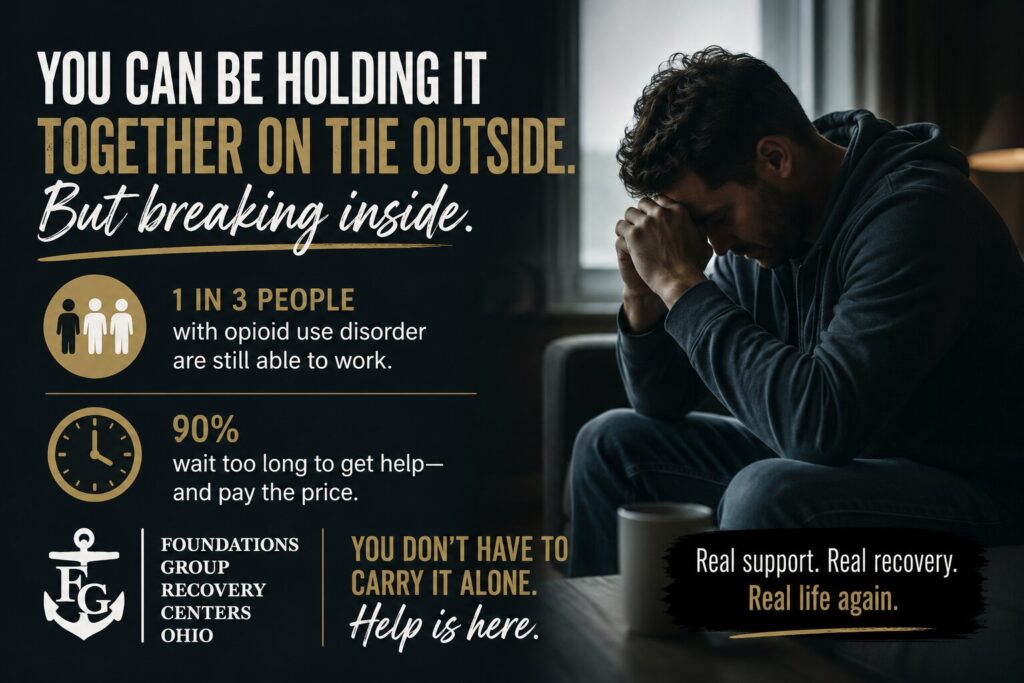
But some of the people struggling the most still wake up early, answer emails, pay bills, and show up exactly where they’re expected to be.
That’s part of what makes high-functioning addiction so dangerous.
From the outside, life can still look “fine.” Internally, though, everything starts revolving around one thing: not getting sick.
At Foundations Group Recovery Center Ohio’s opiate addiction treatment program, we speak with many people who spent years convincing themselves they didn’t qualify as someone who needed help because they were still functioning.
Still employed.
Still parenting.
Still surviving.
But survival and stability are not always the same thing.
And eventually, even the people who hide it best get tired.
High-Functioning Addiction Often Looks Like Exhaustion, Not Chaos
One patient once told me:
“Nobody knew how bad it was because I never stopped moving.”
He worked full-time. Paid his mortgage. Made it to family events. From the outside, he looked dependable.
But underneath all of that was constant panic.
Would he have enough to avoid withdrawal tomorrow?
Could he stretch what he had through the weekend?
Would he start getting sick during work?
Could he keep hiding this from people another month?
That’s the part many people never see.
High-functioning addiction is often less about dramatic collapse and more about relentless emotional maintenance. Every day becomes organized around avoiding withdrawal, managing symptoms, hiding stress, and appearing normal.
It becomes exhausting in a way that’s hard to explain to people who haven’t lived it.
Like running a marathon in dress shoes while pretending you aren’t out of breath.
The Search for Help Usually Starts Quietly
Most people don’t announce they’re looking for treatment.
They search privately.
Late at night. During lunch breaks. Sitting in parking lots. In work bathrooms. Next to sleeping partners who have no idea how overwhelmed they’ve become.
And often, the searches themselves tell a story.
Not “How do I completely transform my life?”
More like:
- “Can I get help without losing my job?”
- “Are there walk-in options?”
- “Will Medicaid cover treatment?”
- “Can I still work while getting help?”
- “Can I start without everyone finding out?”
These are survival questions.
A lot of people searching for affordable opioid treatment are not avoiding recovery because they don’t care. They’re avoiding it because they’re terrified treatment will blow up the fragile life they’ve worked so hard to hold together.
That fear keeps many people trapped longer than they should be.
The Hidden Cost of Waiting Too Long
High-functioning people often become experts at rationalizing delay.
“I’ll stop after this project.”
“I just need to get through the holidays.”
“I’m handling it.”
“I’m not as bad as other people.”
But addiction tends to grow quietly.
Tolerance builds. Emotional exhaustion deepens. Anxiety increases. Isolation expands. The mental energy required to maintain appearances becomes heavier and heavier.
Eventually, life starts shrinking around the addiction.
One patient described it this way:
“At first, opioids fit into my life. Eventually my life fit around opioids.”
That shift happens gradually enough that many people barely notice it until they suddenly realize every decision revolves around avoiding withdrawal, finding stability, or staying hidden.
That realization can feel terrifying.
But it can also become the beginning of honesty.
Walk-In Access Matters Because Readiness Doesn’t Last Forever
This is something people outside addiction treatment often misunderstand.
Motivation during active addiction can disappear quickly.
Someone may finally decide at 2am that they’re ready for help. By the next afternoon, fear and shame may already be talking them out of it again.
That’s why immediate access matters so much.
When people search for care that accepts Medicaid or allows walk-ins, they’re often searching during one of the few moments where hope briefly outweighs fear.
Delays can become dangerous.
Not because people don’t want recovery, but because addiction trains people to doubt themselves constantly.
Many individuals searching for Suboxone clinics Columbus are not looking for a perfect solution overnight. They’re looking for a realistic first step that feels possible financially, emotionally, and logistically.
And honestly, realistic matters.
Medication Support Can Create Breathing Room
A lot of patients carry shame about needing medication-assisted treatment.
They worry it means they’re “still addicted.” They worry people will judge them. Some have even been told they should be able to quit through willpower alone.
But opioid addiction is not a character flaw.
It affects the nervous system, stress response, brain chemistry, sleep, emotional regulation, and physical functioning. Withdrawal alone can feel overwhelming enough to push people right back into using even when they desperately want to stop.
Medication support can help reduce cravings, stabilize withdrawal symptoms, and create enough breathing room for recovery work to actually begin.
And for many people, that breathing room changes everything.
One patient described it this way:
“It was the first time in years my brain stopped screaming long enough for me to think.”
That matters more than people realize.
Because recovery becomes much more possible once survival mode slows down.
Recovery Is Often Less Dramatic Than People Expect
Movies tend to portray recovery as one giant breakthrough moment.
Real recovery is usually quieter.
It looks like:
- Sleeping through the night again
- Going to work without panic
- Eating consistently
- Feeling emotionally present during conversations
- Laughing naturally for the first time in months
- Not structuring your day around withdrawal anymore
- Being able to think about the future again
These moments may sound small to outsiders.
To someone trapped in addiction, they can feel enormous.
Especially after years of living with constant fear underneath everyday life.
People Don’t Need to “Lose Everything” to Deserve Help
This may be the biggest misconception high-functioning people carry.
They believe treatment is only for people who have completely fallen apart.
But many people seek treatment before total collapse happens.
They seek help because:
- They’re exhausted
- Their mental health is deteriorating
- Their relationships feel emotionally distant
- They’re tired of lying
- Their anxiety is getting worse
- They’re scared of where things are heading
- They no longer recognize themselves
And honestly, reaching out earlier can save people years of suffering.
Addiction does not need to become catastrophic before it becomes serious.
The Relief Often Starts Before Recovery Feels Real
One thing I notice repeatedly in treatment is how emotional people become once they realize they no longer have to carry everything alone.
Not because everything is magically fixed overnight.
Because secrecy is exhausting.
Pretending is exhausting.
Living two separate lives is exhausting.
For many people, the first real feeling of relief happens the moment they stop hiding how hard things have become.
And that honesty can become incredibly powerful.
Especially for high-functioning individuals who spent years convincing themselves they should be able to “handle it.”
FAQ About Medicaid, Walk-In Treatment, and Opioid Recovery
Can I get opioid treatment if I have Medicaid?
Many treatment programs accept Medicaid coverage for opioid addiction treatment and medication-assisted treatment services. Coverage can vary, but affordable options do exist, including outpatient and structured support programs.
Are walk-in addiction treatment options available?
Some treatment providers offer walk-in assessments or same-day intake options. Immediate access can be important because many people seek help during brief moments of readiness and urgency.
Do I have to quit my job to get treatment?
Not always. Many people continue working while participating in outpatient care, medication-assisted treatment, or multi-day weekly treatment programs. Treatment plans are often designed to support real-life responsibilities.
Is medication-assisted treatment replacing one addiction with another?
No. Medication-assisted treatment is designed to stabilize withdrawal symptoms and reduce cravings so people can focus on recovery, daily functioning, and long-term healing.
What if I’m still functioning normally?
High-functioning addiction is still addiction. You do not need to lose your job, relationships, or home before seeking support. Many people enter treatment while still managing daily responsibilities.
Why do people delay treatment even when they know they need help?
Fear plays a major role. Fear of judgment, withdrawal, finances, work disruption, or failure can keep people stuck for long periods of time. Shame often convinces people they should keep handling things alone.
What if I’m not completely sure I’m ready?
Most people are not fully confident when they first reach out. Recovery usually begins before certainty shows up. Sometimes one honest conversation is enough to begin moving forward.
You don’t have to keep carrying this alone while pretending everything is still manageable.
Call (888)501-5618 or visit our opiate addiction treatment services to learn more about our substance use treatment Ohio, opiate addiction treatment services in Columbus, Ohio.